The Golden Sand Ceiling: How Tauranga’s Affordability Crunch Is Diverting Growth into Western Bay Satellites
For years, commentary surrounding residential property stress in New Zealand centred squarely on Auckland. Yet across recent economic cycles, Tauranga has solidified its position as the country’s most severely stretched housing market. Historical metrics from CoreLogic reveal that Tauranga maintains the highest value-to-income ratio among all main centres, hovering near 8.8 to 9.0. In contrast, Auckland trades at roughly 7.5, while Wellington sits closer to 6.4.
This persistent valuation gap highlights a regional imbalance: Tauranga demands tier-one property prices on provincial salary bands. While the Auckland region supports deeper corporate payrolls, Tauranga’s employment market leans heavily on horticulture, logistics, construction, healthcare, and services. When property prices decouple from local earning capacity to this extent, buyer behaviour is forced to adapt. The outcome is what industry analysts refer to as the golden sand ceiling, an economic barrier driving homebuyer capital and medium-density development away from the coastal strip and outward into Western Bay of Plenty satellite towns.
The Coastal Strip Encounters Its Economic Barrier
The core of this affordability challenge remains the strip running from Mount Maunganui down to Pāpāmoa. Mount Maunganui continues to trade at a substantial premium, with Real Estate Institute of New Zealand (REINZ) reports recording median prices comfortably above $1.25 million, and waterfront assets fetching multiple millions. Despite periodic market corrections, the Mount operates largely as an equity-driven pocket, supported by intergenerational wealth, retirees, and equity flowing from Auckland movers.
Further down the coast, Pāpāmoa once provided a more accessible alternative for growing families. Extensive greenfield expansion over the past two decades turned Pāpāmoa into a high-volume suburban powerhouse. Today, however, REINZ figures show median values across Pāpāmoa settling in the $840,000 to $890,000 range. For first-home purchasers and median-income working households, that entry threshold demands considerable cash equity or secondary financial support that current lending environments make difficult to secure.
CoreLogic debt servicing indicators show that servicing an average mortgage on an average Tauranga home continues to consume roughly 45 to 50 percent of gross median household earnings. This sits well above the historical national baseline of around 40 percent. Faced with strict bank stress-testing rates and debt-to-income rules, domestic demand is hitting an absolute ceiling along the beachfront suburbs.
Capital Reallocates Across the Western Bay of Plenty
With entry barriers rising along the coast, purchasing power is adjusting course toward the Western Bay of Plenty District Council boundary. This shift is not merely geographic; it is driven by fundamental land economics. Lower land assembly costs, practical planning provisions, and realistic price-per-square-metre metrics make the outer corridors increasingly viable for both home purchasers and large-scale builders.
Sales transaction patterns from REINZ highlight this dispersion. While transaction numbers across established central Tauranga suburbs remain modest, activity across satellite markets has shown sustained resilience. Buyers are calculating the tradeoff between immediate beach access and everyday balance-sheet stability, concluding that satellite hubs offer far more achievable homeownership pathways.
Ōmokoroa Becomes a Master-Planned Density Node
To the north-west, the Ōmokoroa peninsula provides the clearest example of this outward structural shift. What was once an orchard-lined coastal village is now undergoing comprehensive urban development, supported by State Highway 2 safety upgrades and continuous progress on the Takitimu North Link roading project.
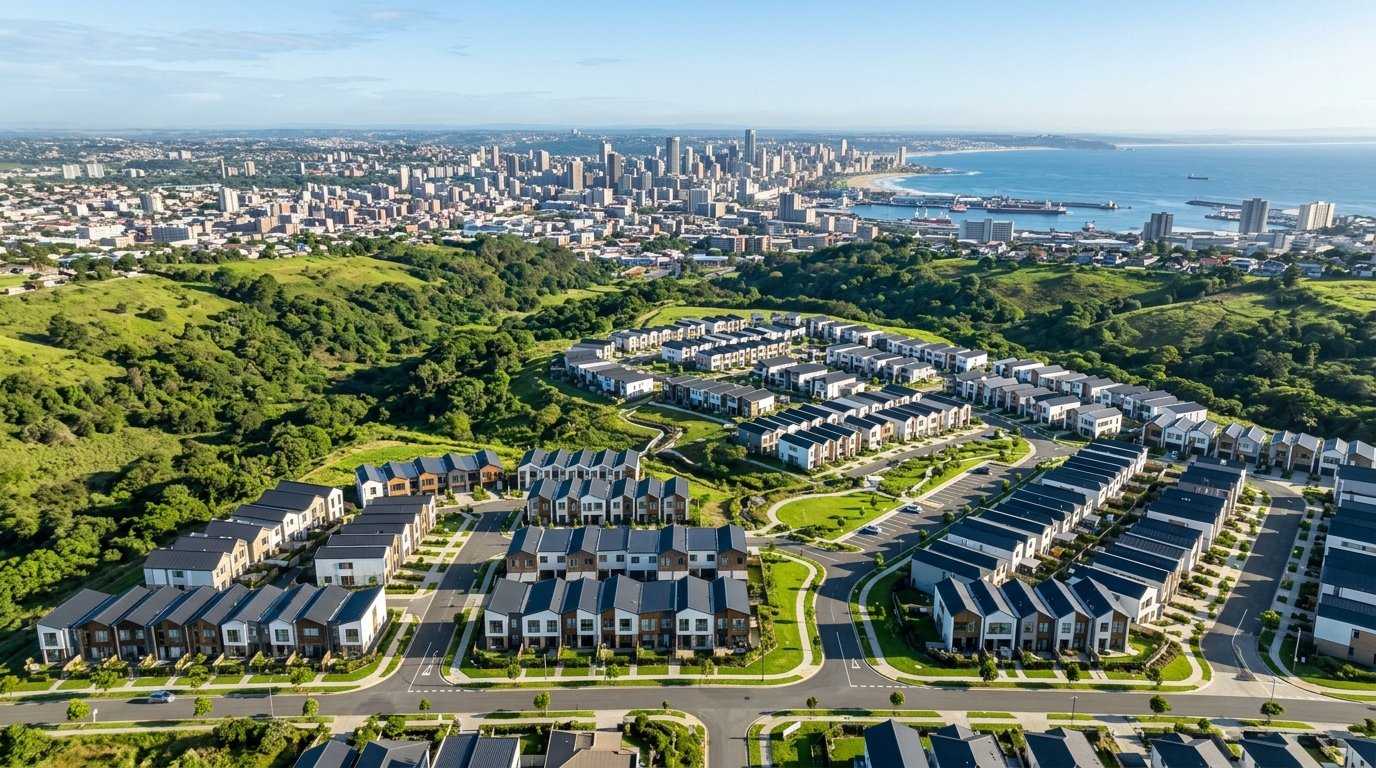
Planning policies have enabled modern medium-density construction across Ōmokoroa that rarely eventuates in established Tauranga neighbourhoods. Terraced rows, duplexes, and compact standalone designs are being built within integrated master-planned communities, creating turnkey purchase opportunities between $750,000 and $850,000.
- Turnkey build packages meeting current thermal, acoustic, and insulation codes.
- Coordinated local infrastructure, including educational facilities, civic spaces, and commercial village centres.
- Price differentials of 20 to 30 percent when measured against comparable modern homes in Pāpāmoa.
- Lifestyle appeal centred on harbour access, public boat ramps, and cycle trail networks.
For buyers locked out of Mount Maunganui, Ōmokoroa preserves coastal water access while presenting a debt profile that fits within standard retail banking guidelines.
Te Puke and the Industrial Employment Corridor
To the south-east, Te Puke is experiencing a similar influx of residential demand. Long viewed as a rural service town, Te Puke has emerged as an attractive solution for buyers searching for residential assets below the $800,000 mark. REINZ sales data reveals Te Puke’s median price tracking near $790,000, creating an immediate discount compared to neighbouring coastal postcodes.
Underpinning Te Puke’s housing market is genuine regional employment. Connected to Tauranga via the Tauranga Eastern Link, the township sits beside the emerging Rangiuru Business Park. This extensive industrial hub is slated to bring thousands of long-term jobs across primary processing, warehousing, and freight distribution over the coming decade.
Subdivisions around Te Puke are attracting working families who value short daily commutes to regional industrial engines without taking on million-dollar residential debt. Builders are prioritising efficient lot layouts and modest three-bedroom typologies, catering directly to working-class household budgets.
Development Economics and Planning Realities
From an investment and development perspective, satellite locations offer practical execution advantages. Central Tauranga is geographically constrained between the harbour, estuarine inlets, and steep topography. Assembling brownfield sites within Tauranga City involves aging three-waters infrastructure, high holding costs, and lengthy consent procedures.
Western Bay of Plenty growth corridors offer master-planned tracts where civil infrastructure can be deployed efficiently at scale. Lower land development costs allow civil contractors and group home builders to deliver turnkey packages at prices that align with current mortgage servicing constraints, ensuring stock moves swiftly off the balance sheet.
Long-Term Outlook for the Western Bay Conurbation
This flow of residential investment signals a permanent transformation in how the Bay of Plenty functions. Tauranga is evolving from an isolated coastal city into a connected, multi-nodal conurbation.
Mount Maunganui and ocean-side Pāpāmoa will likely retain their scarcity value, serving an affluent ownership demographic anchored by established wealth. However, the heavy lifting of population growth, affordable housing supply, and workforce settlement will run straight through satellite corridors. By absorbing local purchasing demand, Ōmokoroa and Te Puke have stepped up as the essential relief valves sustaining the wider region’s economic viability.