Queenstown-Lakes Decouples From Stagnant National Market as Land Scarcity Fuels Record Valuations
A Tale of Two Markets: Southern Resilience vs Metropolitan Fatigue
New Zealand’s wider residential property landscape remains trapped in a prolonged phase of consolidation. According to Quotable Value (QV) data, the national average home value has eased to $890,508, weighed down by substantial listing inventory, elevated debt-servicing requirements, and cautious household balance sheets across the North Island. Auckland’s regional average sits at $1,155,065, while Wellington City values have drifted down to $868,540 after consecutive months of softness.
The Queenstown-Lakes District continues to chart a completely independent course. Far from succumbing to the headwinds dampening turnover in metropolitan centres, the southern resort corridor has decoupled from national trends. QV valuation assessments establish the district’s average residential value at $2,035,732, with the underlying median sitting at $1,610,000. The total rateable capital value across the district’s 32,604 properties has expanded to $74.5 billion, underscoring an extraordinary accumulation of private wealth that defies broader economic gravity.
Severe Topographical Limits Anchor Base Land Values
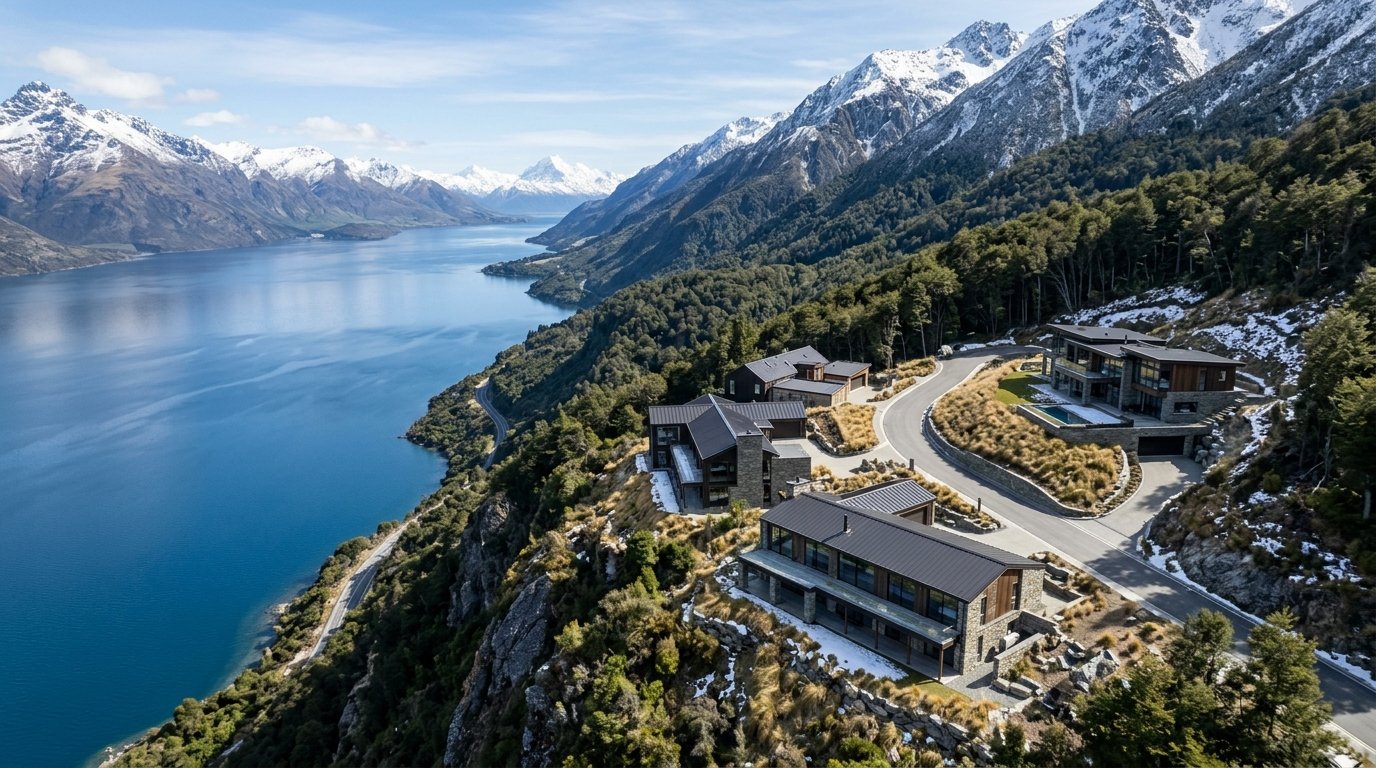
The principal structural engine behind this divergence is raw physical scarcity. Unlike Auckland, Christchurch, or Hamilton, where horizontal sprawl can absorb residential expansion across peripheral greenfield boundaries, Queenstown-Lakes is bound by severe natural barriers. Squeezed between steep glacial mountain ranges, alpine rivers, and protected lake margins, developable residential land is finite.
This baseline physical constraint is directly reflected in valuation data:
- The average residential land value alone across Queenstown-Lakes has reached $1,076,925, accounting for more than 52% of total property capital value.
- Median district land value stands at $860,000, representing a cost threshold higher than the total purchase price of an entire standalone home in several regional provincial centres.
- Infrastructure delivery costs through rocky alpine terrain and strict natural hazard overlays have added hundreds of thousands of dollars to civil development stages, establishing an insurmountable cost floor under new subdivision sections.
Because the physical earth represents such an overwhelming proportion of an asset’s end worth, depreciation of dwellings plays a negligible role in local price adjustments. Value accrues directly to the underlying title, sheltering the district from the inventory-led price discounting seen in fringe subdivisions across greater Auckland and Canterbury.
Planning Constraints and Visitor Accommodation Controls
Compounding geographic bottlenecks are the district’s regulatory settings. The Queenstown Lakes District Council (QLDC) Operative and Proposed District Plans place strict parameters around visitor accommodation (VA) activities in low and medium-density residential zones. Rules capping unconsented peer-to-peer short-term letting at 90 days per calendar year have effectively split the residential stock into two distinct commercial tiers.
Properties retaining established resource consents or existing use rights for 365-day visitor accommodation command severe pricing premiums. Investors seeking yield look to capitalise on strong year-round tourism flows, where managed short-term lets generate gross revenue yields well in excess of standard tenancy agreements. In turn, residential properties located in high-amenity zones that secure consent for short-term operation rarely return to the permanent rental or entry-level ownership pool.
At the same time, requirements around design controls, infrastructure contributions, and urban growth boundaries make the delivery of affordable high-density units financially challenging for private developers. The resulting friction between workforce housing shortages and tourist capacity creates an unrelenting supply deficit, which maintains upward pressure on existing dwelling prices.
The Insulated Capital Profile of Resort Purchasers
While standard suburban markets depend on domestic wage growth, bank debt-to-income multiples, and retail floating mortgage interest rates, Queenstown-Lakes is underpinned by an entirely different demographic profile. The buyer pool across the Southern Lakes is dominated by high-equity owner-occupiers, business owners, early retirees, and intergenerational family trusts.
Many buyers relocating to the basin fund purchases through unencumbered capital generated from business sales or equity built within high-value northern property holdings over several decades. For these purchasers, a 100-basis-point swing in domestic retail interest rates has little material influence on transacting decisions. The presence of non-bank domestic liquidity shields the upper tier of the market from Reserve Bank monetary tightening cycles, preventing the forced liquidations that frequently emerge in highly leveraged metropolitan fringe corridors.
Submarket Breakdowns: Queenstown, Wanaka, and Arrowtown
Across the wider district, individual submarkets exhibit distinct micro-dynamics while sharing the common thread of inventory compression:
- Queenstown: The central resort hub and surrounding enclaves—including Kelvin Heights, Queenstown Hill, and Lake Hayes—anchor the upper luxury stratum. Modelled values across Queenstown sit around $1.99 million. While mid-tier entry markets such as Frankton and Hanley’s Farm have experienced modest transaction pacing as first-home buyers encounter lending hurdles, premium lakefront and elevated view corridors continue to clear above multi-million-dollar reserves.
- Wanaka: North of the Crown Range, Wanaka has emerged as an even tighter lifestyle market. Recent QV readings position Wanaka’s average residential value at approximately $2.05 million. Demand remains exceptionally consistent among domestic semi-retirees and remote executives seeking proximity to outdoor infrastructure without Queenstown’s commercial congestion, keeping local listing periods compressed.
- Arrowtown: Arrowtown maintains the most acute supply bottlenecks in the South Island. Constrained by a strict historic residential overlay, an established green belt, and the impossibility of outward expansion, the enclave functions virtually as a closed system. Sales volumes are low, and median sale levels frequently push past $2.4 million. Properties in old Arrowtown change hands predominantly off-market or through competitive single-agency tenders, ensuring baseline price retention even during quiet winter quarters.
A Structural Divide Unlikely to Close
The persistent outperformance of the Queenstown-Lakes property sector is not an ephemeral market cycle; it is the mathematical outcome of structural scarcity meeting concentrated capital. With local development infrastructure contributions climbing, the district council facing strict borrowing limits on three-waters network expansions, and physical geography precluding expansive outward builds, supply cannot accelerate to meet demand.
As metropolitan hubs work through excess residential inventory and gradual economic recovery, the Southern Lakes district operates on a separate axis entirely. Until the physical boundaries of the basin expand or international appeal subsides, Queenstown-Lakes will remain New Zealand’s premier property market exception.