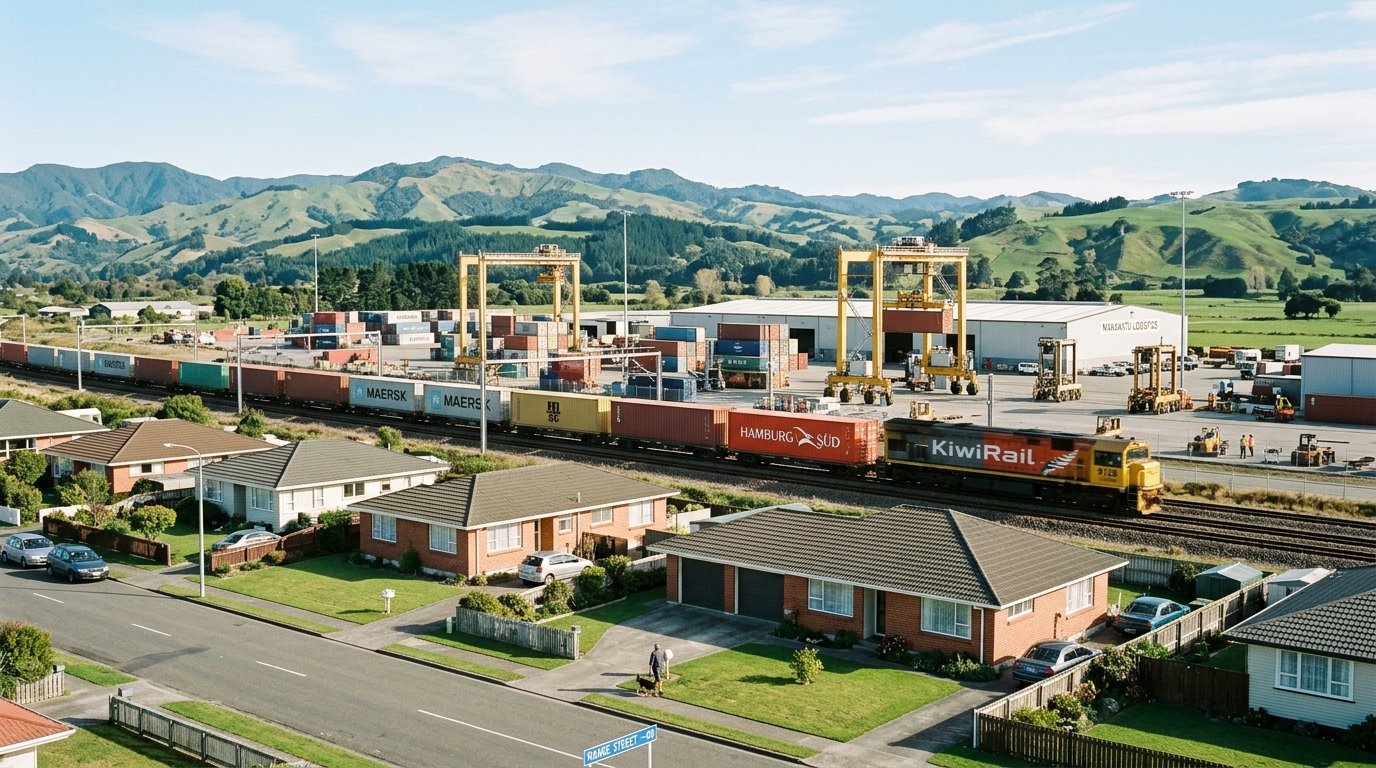
The Heartland Logistics Pivot: How Infrastructure and Sub-$600k Pricing Are Anchoring Palmerston North and Feilding
While New Zealand’s metropolitan property markets have navigated uneven recovery curves and extended listing durations, the Manawatū basin continues to demonstrate structural resilience. Anchored by the dual forces of major freight infrastructure and tangible entry-level affordability, Palmerston North and neighbouring Feilding have carved out a position of stability. Data from the Real Estate Institute of New Zealand (REINZ) reveals an active regional marketplace where buyer turnover remains liquid and gross yields on entry-tier assets consistently sit above 5.5%.
Macro Insulation and Regional Liquidity
The Manawatū residential market has largely avoided the sharp value recalibrations observed in Wellington and parts of Auckland over recent quarters. REINZ housing data indicates that the Palmerston North median sale price is holding steady around $615,000, while the wider Manawatū district registers an average property value of approximately $563,000. This pricing framework creates an accessible threshold for owner-occupiers and balance-sheet-focused investors alike.
Transaction velocity across the city reflects this steady baseline. Sales volumes in Palmerston North have recorded monthly increases exceeding 20% in late 2026, with properties taking a median of roughly 42 days to sell. Compared to the extended marketing campaigns required in high-median metropolitan centres, the basin is benefiting from an active, domestic buyer pool whose purchasing capacity remains well within current lending constraints.
The Logistics Backbone: KiwiRail Regional Freight Hub and Te Utanganui
Underpinning this residential steadiness is an unprecedented expansion of the region’s commercial and industrial spine. Positioned at the junction of State Highways 1, 2, and 3, Manawatū is solidifying its status as central New Zealand’s freight crossroads through the master-planned Te Utanganui distribution initiative. Central to this strategy is the KiwiRail Regional Freight Hub located between Palmerston North and Bunnythorpe.
With up to $22.4 million committed through the government’s Regional Infrastructure Fund to de-risk and advance rail construction works, this intermodal hub is designed to handle rising domestic and international cargo movements. Complemented by 24/7 air-freight operations at Palmerston North Airport and major transport improvements like Te Ahu a Tūranga (the Manawatū-Tararua Highway), the region is attracting substantial industrial investment.
This multi-modal infrastructure directly reinforces residential housing demand across the basin through several channels:
- Long-term employment creation across logistics, distribution, advanced manufacturing, and civil engineering.
- Substantial permanent relocations by transport operators, drawing skilled operational staff into the region.
- A diversified local economy that shields domestic workers from public-sector restructuring cycles seen in the capital.
- Ongoing capital expenditure that bolsters local subcontractor networks and ancillary commercial services.
Yield Dynamics and Sub-$600k Affordability
Investor appetite in the region has pivoted sharply toward high-yielding, defensive residential stock. Gross rental yields across standard Palmerston North residential assets generally track between 5.0% and 6.5%, significantly outperforming the sub-4.2% returns typical of Auckland and Wellington. With city-wide median rents hovering around $550 to $580 per week according to Tenancy Services data, gross yields on sub-$600,000 stock frequently exceed the 5.5% mark.
This income cushion allows landlords to achieve near cash-flow neutrality in an easing interest rate environment. First-home buyers are equally active in this tier, capitalising on regional price caps and realistic debt-to-income multiples. In suburbs like Highbury, Westbrook, and Awapuni, entry-level standalone homes on full sections regularly trade between $420,000 and $550,000, providing an accessible pathway into homeownership without excessive leverage.
Suburb Divergence: Hokowhitu and Kelvin Grove
Performance within Palmerston North is not uniform; distinct micro-markets cater to diverging buyer mandates. Suburbs north of the city centre are reacting directly to commercial expansion, while southern pockets retain their established residential prestige.
Kelvin Grove has become a focal point for modern family housing and investor interest. Located directly adjacent to the expanding North East Industrial Zone and within easy reach of the KiwiRail Regional Freight Hub, the suburb posts average sale values between $720,000 and $735,000. Median days to sell in Kelvin Grove routinely sit below 25 days, reflecting robust demand for low-maintenance, post-2000s housing stock from logistics professionals and expanding households.
At the upper end of the city’s hierarchy, Hokowhitu provides capital stability. Positioned along the Manawatū River with close proximity to Massey University, the suburb features a median sale price near $725,000, with prime river-facing and character properties exceeding seven figures. Hokowhitu continues to command premium pricing due to tight supply, high-decile school zoning, and sustained appeal among medical staff from Palmerston North Hospital and university faculty.
Feilding: The Satellite Release Valve
Fourteen kilometres northwest, the historic rural town of Feilding is capturing significant spillover demand from Palmerston North’s urban core. Operating as both an agricultural service center and a commuter satellite, Feilding offers a distinct pricing advantage with median values running between $520,000 and $560,000.
Feilding appeals to buyers seeking traditional quarter-acre character properties and modern master-planned subdivisions at a discount to equivalent Palmerston North stock. With short, congestion-free arterial connections to the KiwiRail site and northern industrial parks, Feilding represents an affordable option for regional workers. Rental yields here remain consistent with the wider basin, routinely yielding 5.3% to 5.8% on standalone three-bedroom homes.
Market Outlook
The Manawatū residential market presents a compelling case study in fundamentals-driven real estate. Rather than relying on debt-fuelled speculative surges, Palmerston North and Feilding are anchored by productive land use, critical freight connectivity, and attainable pricing.
As physical construction milestones advance at the KiwiRail Regional Freight Hub and associated transport links open across the region, supply chain employment will continue to expand. For property market participants navigating the current cycle, the combination of sub-$600,000 entry points and yields above 5.5% positions the Manawatū basin as one of New Zealand’s most durable property corridors.