The Two-Year Turnaround: Exploiting the Restored Bright-Line Rule to BRRRR Affordable Stock in Palmerston North
The New Framework for Value-Add Property Investment
New Zealand’s residential property landscape has undergone a distinct structural pivot over the past eighteen months. As broad capital growth across the main metropolitan centres continues to tread water, active investors are shifting attention toward regional housing hubs where entry prices remain accessible and rental yields hold firm. Palmerston North, anchored in the wider Manawatū economic basin, has emerged as one of the most compelling locations for executing systematic value-add strategies.
This geographic focus is propelled by two major regulatory changes. The coalition government’s amendment to the Income Tax Act restored the bright-line property test to a two-year threshold from 1 July 2024, repealing the punitive ten-year horizon that previously locked residential capital in place. Simultaneously, the unwinding of overly prescriptive affordability rules under the Credit Contracts and Consumer Finance Act (CCCFA) removed the forensic examination of personal living expenses that had constrained bank lending. Lenders like Kiwibank now operate with improved flexibility when assessing equity top-ups and refinancing requests.
Together, these policy corrections create an ideal operational backdrop for the BRRRR model: Buy, Renovate, Rent, Refinance, Repeat. By targeting unrenovated homes in Palmerston North, investors are manufacturing immediate equity through controlled cosmetic refurbishments, capturing improved rental yields, and refinancing to release capital without enduring capital gains tax drag.
The Income Tax Act and the Power of the Two-Year Window
The reduction of the bright-line test under the Income Tax Act fundamentally alters the risk calculus of short-to-medium-term residential investment. Under the former ten-year rule, any property sold within a decade was vulnerable to income tax on capital appreciation at the owner’s marginal tax rate, unless an exemption applied. This framework heavily disincentivised equity recycling and penalised investors who needed to adjust their portfolios in response to changing market conditions.
The current two-year bright-line clock fits the natural lifecycle of a cosmetic BRRRR project. An active refurbishment typically requires eight to twelve weeks on site, followed by twenty to twenty-two months of rental tenancy to establish proof of performance and build a solid cashflow track record. Upon reaching the twenty-four-month milestone, the property owner gains strategic flexibility:
- Retain the property as a long-term cashflow asset, benefiting from the full restoration of mortgage interest deductibility and strong regional yields.
- Liquidate the property to harvest realised equity completely outside the bright-line tax perimeter, provided the asset was not acquired with an overt intention of trade or business dealing under other sections of the tax code.
- Refinance against a refreshed valuation, using the extracted capital to fund the next regional acquisition while keeping the original dwelling in the portfolio.
By compressing the mandatory holding timeline, the amended legislation removes the danger of stranded equity and gives portfolio builders a dependable exit route if interest rate pressure or personal circumstances dictate a disposal.
Manawatū Market Fundamentals: What CoreLogic NZ Data Shows
Executing a successful capital-recycling strategy requires a market with stable underlying demand, an entry point that does not stretch debt capacity, and healthy gross yields. Palmerston North delivers across all three criteria. Data from CoreLogic NZ indicates that the city’s median property value sits around $592,000, standing well below the national median of approximately $800,000 and representing less than half the median cost of an equivalent standalone house in central Auckland.
CoreLogic figures reveal that gross rental yields in Palmerston North average between 4.8% and 5.2% across the wider urban area, with select working-class pockets generating returns between 5.8% and 6.5%. By comparison, gross yields across central Auckland and Wellington struggle to surpass 3.5% to 4.2%. These figures underline why the Manawatū basin provides sufficient cashflow insulation to sustain leverage during the holding phase.
The city’s housing composition provides a rich inventory of renovation candidates. Suburbs such as Takaro, Highbury, Westbrook, and Awapuni contain extensive tracts of 1950s, 1960s, and 1970s weatherboard and brick-and-tile dwellings on full freehold sites. Many of these properties trade in the $420,000 to $490,000 range, featuring tired interiors, dated kitchens, and non-compliant heating. Their underlying structural integrity remains sound, allowing investors to complete high-impact renovations without the complexity or cost of building consents.
Rental demand in the city is underpinned by institutional anchors that remain immune to standard economic downturns. These drivers include Massey University, the MidCentral District Health Board and Palmerston North Hospital, the New Zealand Defence Force bases at Linton and Ohakea, and large-scale regional logistics hubs serving the lower North Island.
The Refinancing Mechanics: Eased CCCFA and Kiwibank Lending
The central hurdle of the BRRRR strategy has historically occurred during the refinance stage. Under the stringent CCCFA regime introduced in December 2021, bank underwriters were forced to tally discretionary spending, scrutinise minor personal expenses, and impose ultra-conservative repayment buffers. This administrative friction often prevented investors from releasing equity, even when substantial value had been created on site.
The rollback of these prescriptive requirements by the Ministry of Business, Innovation and Employment has restored practical discretion to mainstream mortgage desks. Kiwibank and other retail lenders now rely on standardised household expenditure benchmarks and realistic affordability tests, streamlining the path for property owners seeking to redraw capital against completed capital works.
A representative Takaro transaction illustrates the operational mathematics:
- Acquisition: An investor buys a neglected 1960s three-bedroom weatherboard home for $440,000, funding the purchase with a 30% cash deposit of $132,000 and a bank mortgage of $308,000.
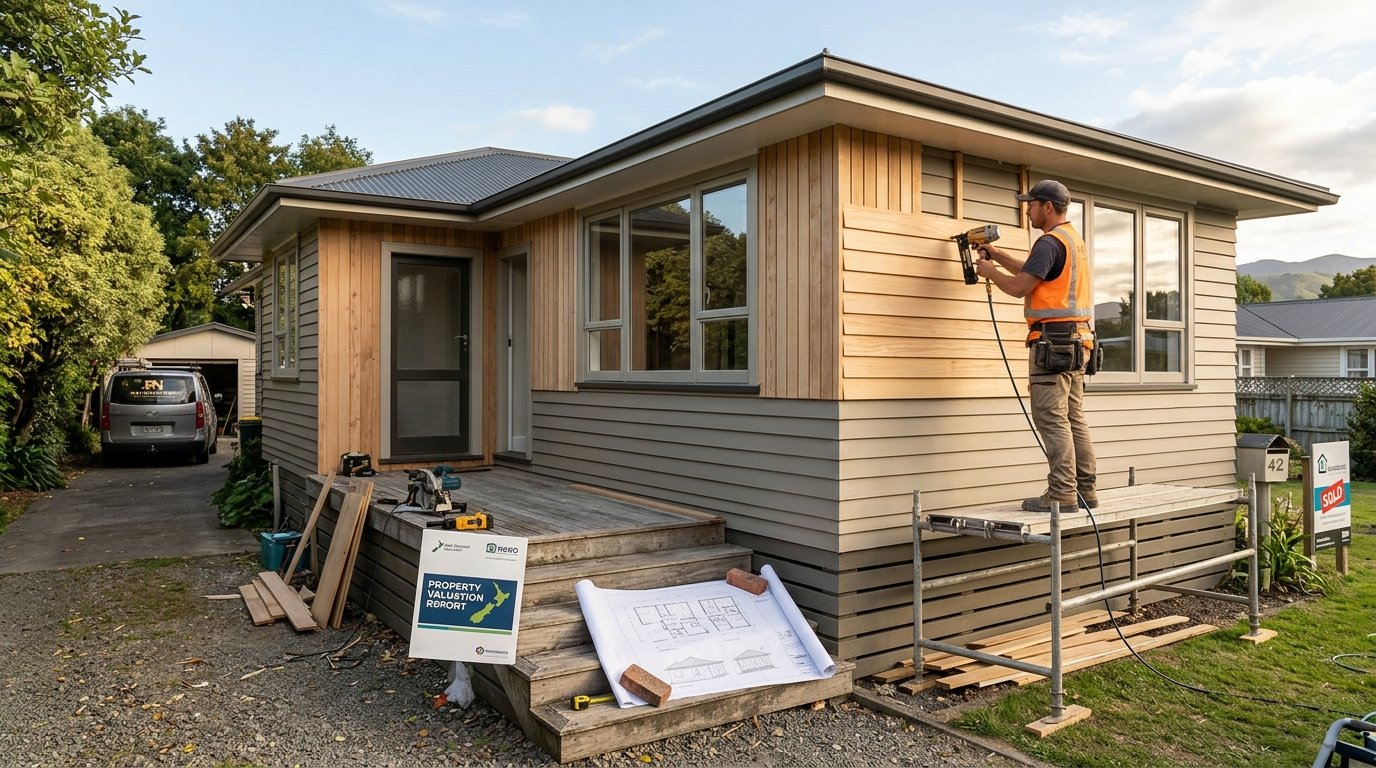
- Renovation: Over eight weeks, the investor directs $38,000 into cosmetic modernisations, including modern kitchen joinery, hardwearing hybrid plank flooring, interior painting, energy-efficient LED lighting, and heat pump installation to meet Healthy Homes standards. Total capital committed reaches $478,000.
- Tenancy: The upgraded home is let at $560 per week, up from an unrenovated market potential of $430 per week, generating an annual gross rental revenue of $29,120.
- Refinancing: A registered valuer assesses the completed home at $560,000. Kiwibank advances a loan at a 70% investor loan-to-value ratio, unlocking $392,000 in debt capacity.
- Capital Recycling: After clearing the original $308,000 purchase facility, $84,000 of fresh equity is returned. This repays the $38,000 renovation expenditure in full and returns $46,000 of the original cash deposit, ready to deploy into a second acquisition in the Manawatū area.
Controlling Execution Risk in Provincial Centres
While the mathematical foundation of this approach is compelling, execution risks require careful mitigation. Regional renovation projects depend on tight budget discipline. Investors who install high-end stone countertops or architectural fixtures in suburban Palmerston North will struggle to recover their outlay, as the local rental market rewards clean, warm, functional interiors rather than luxury finishes.
Managing trade costs and timelines is equally vital. Holding empty properties during renovation creates carrying costs that erode profit margins. Successful operators secure fixed-price quotes with local licensed trades and coordinate suppliers before property settlement to ensure works begin the day keys are handed over.
Local body overheads must also be factored into initial feasibility models. Changes to the Palmerston North City Council rating structure, which incorporates both land and capital values, mean rate obligations must be audited on every target property to prevent cashflow surprises.
Building Equity with Discipline
The combination of the two-year bright-line test in the Income Tax Act, realistic credit screening from lenders like Kiwibank, and the restoration of full mortgage interest deductibility has created a functional environment for active property investors. By choosing an affordable provincial centre like Palmerston North, operators bypass the heavy capital requirements and low yields of main-centre markets. For those committed to disciplined renovation and precise financial management, the two-year turnaround provides a reliable pathway to compound equity and expand a high-performing property portfolio across the Manawatū.