The Body Corporate Maintenance Deficit: Why Overlooking 10-Year LTMP Reserves in Christchurch Central Can Slap Townhouse Buyers With $45,000 Special Levies
The Post-Quake Rebuild Wave Reaches Its First Capital Cycle
Over the past decade, Christchurch Central and surrounding inner suburbs like Riccarton experienced an unprecedented construction boom. Driven by post-earthquake replacement zoning and permissive planning framework provisions, thousands of medium-density townhouses replaced older detached housing stock. CoreLogic construction and sales records reveal that multi-unit dwellings made up the majority of new residential completions in the Christchurch urban core between 2014 and 2019, creating an accessible price tier for first-home buyers and private residential investors.
Those early waves of rebuild-era medium-density stock are now entering their eighth to twelfth years of service. That milestone represents the exact window in which structural components, modern exterior claddings, flat-roof membranes, shared stormwater detention basins, and automated access gates reach their primary maintenance threshold. While buyers often treat these homes as modern and low-maintenance assets, physical deterioration does not pause for modern designs. When major repairs come due, the financial mechanisms supporting them are frequently found empty.
The Compliance Trap in the Unit Titles Act 2010
The core vulnerability lies in a critical statutory distinction that catches property buyers off guard. Under Section 116 of the Unit Titles Act 2010, every body corporate must establish and maintain a Long-Term Maintenance Plan (LTMP) covering a projection of at least 10 years, or 30 years for large developments containing 10 or more principal units. This plan outlines anticipated building expenses, identifying when exterior re-coating, membrane replacement, and driveway resurfacing will take place alongside estimated project costs.
However, Section 117 of the same legislation contains an exception that developers and budget-conscious committees exploit. Under Section 117, a body corporate must maintain a Long-Term Maintenance Fund (LTMF) to hold cash reserves for those future works, unless owners resolve by special resolution not to establish or fund it. In small-to-medium developments of four to eight units throughout Christchurch Central and Riccarton, investor-heavy committees frequently pass annual motions to opt out of funding the LTMF.
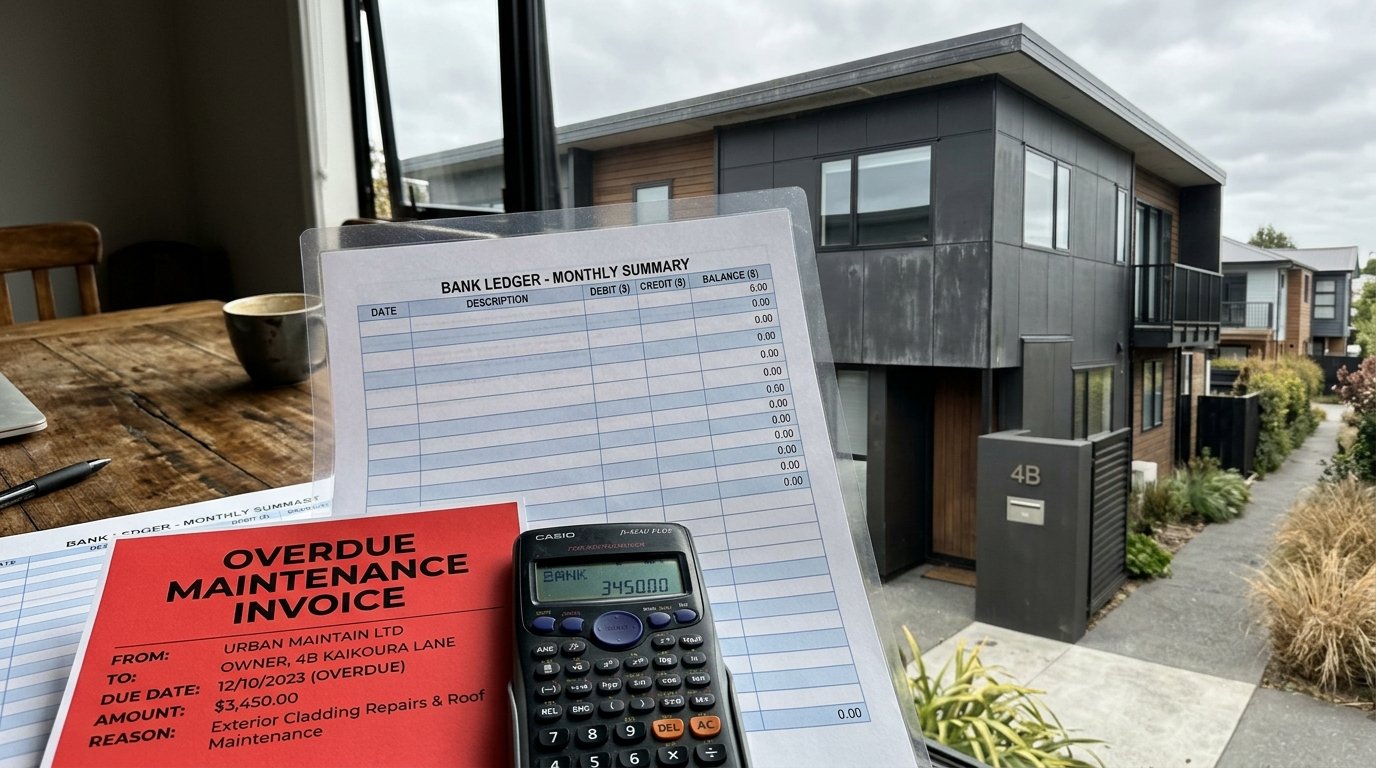
By choosing an unfunded maintenance regime, bodies corporate keep operational levies artificially low. Annual fees between $1,600 and $2,400 per unit create an illusion of low running costs, covering little beyond building insurance and communal electricity. The 10-year plan remains compliant on paper, satisfying basic statutory checks, while the bank account backing that plan holds zero reserves.
The Financial Anatomy of a $45,000 Special Levy
When capital works can no longer be delayed, the consequence of that reserve deficit becomes immediate. Multi-storey terraced developments face high fixed access costs. Painting three levels of exterior cladding requires continuous scaffolding, traffic management plans for tight central city corridors, and containment measures. A standard exterior repaint and sealant refresh across an eight-unit complex frequently totals $180,000 to $220,000. When combined with failing waterproof deck membranes, perimeter fencing renewals, and internal asphalt re-sealing, projects readily reach $360,000.
In an unfunded complex, the body corporate cannot draw on accumulated savings. Instead, the committee convenes an extraordinary general meeting to pass a special levy under Section 121 of the Unit Titles Act 2010. For an owner in an eight-unit scheme holding equal utility interest, an unbudgeted $360,000 invoice translates directly to an immediate cash call of $45,000 per unit, often payable within 30 to 60 days.
When an owner cannot produce that capital, the body corporate holds the legal power to charge recovery interest and pursue statutory debt collection. In extreme cases, failure to pay can lead to court-ordered sales, placing severe financial distress on owners who purchased their property under the assumption that low body corporate fees reflected superior build quality.
What MBIE Disclosures Reveal and What Purchasers Miss
Regulatory updates overseen by the Ministry of Business, Innovation and Employment (MBIE) have attempted to bring transparency to unit title transactions. The Unit Titles (Strengthening Body Corporate Governance and Other Matters) Amendment Act expanded pre-contract disclosure statement requirements. Sellers must now provide prospective purchasers with copies of the long-term maintenance plan, body corporate meeting minutes from the preceding three years, and explicit statements detailing whether an LTMF exists and whether it is funded.
Despite these safeguards, buyers continue to confuse the presence of an LTMP with the presence of capital. Reviewing an engineer-prepared 10-year plan that accurately schedules painting for Year 10 gives unadvised buyers false confidence. The Ministry of Business, Innovation and Employment regularly points out that evaluating the plan requires reading the financial balance sheet alongside it. A pristine plan without a matching dedicated bank account simply acts as an itemised list of future out-of-pocket liabilities.
Tribunal disputes logged with MBIE also highlight rising friction inside small Christchurch schemes where owner-occupiers want to perform preventative maintenance, but offshore or non-resident landlords repeatedly vote against funding the reserve to preserve net rental cash flow. When emergency remediation arrives, the friction spills into formal dispute proceedings, freezing sales campaigns and complicating refinances across the entire complex.
Yield Destruction and Valuation Realities
CoreLogic data shows that central Christchurch townhouses have delivered gross rental yields averaging 4.8 to 5.4 percent, making them popular with private landlords. A two-bedroom unit generating $550 per week produces approximately $28,600 in gross annual rent. A sudden $45,000 special levy instantly wipes out more than eighteen months of gross income, destroying portfolio profitability and compounding interest costs if the owner must draw down personal mortgages to settle the invoice.
Mortgage lenders are increasingly vigilant. Major retail banks in New Zealand now scrutinise body corporate balance sheets before approving finance on unit-titled properties in Christchurch Central and Riccarton. Underwriters who encounter unfunded maintenance plans alongside deferred exterior repairs are reducing allowable loan-to-value ratios or inserting retention conditions that force borrowers to hold surplus liquid capital.
The Essential Pre-Settlement Checklist for Unit Titles
Purchasers assessing medium-density housing across Canterbury must conduct targeted due diligence on body corporate governance before entering unconditional purchase agreements:
- Confirm the precise cash balance held within the Long-Term Maintenance Fund, not merely the operating account.
- Cross-reference the 10-year maintenance expenditure forecast against the current reserve balance to measure the capital deficit.
- Scrutinise the past three years of Annual General Meeting minutes for Section 117 opt-out resolutions and deferred maintenance debates.
- Review the utility interest allocation table to identify the exact percentage share of future special levies assigned to the unit.
- Check whether the body corporate has consulted a qualified quantity surveyor or building consultant to review maintenance cost assumptions within the last 36 months.
A townhouse in Christchurch Central with a $3,500 annual body corporate fee and a fully funded long-term maintenance reserve represents far safer value than an identical property in Riccarton boasting a $1,800 levy and zero accumulated savings. Buying into a unit title means buying into shared financial responsibility. Overlooking the reserve account transforms what looked like an affordable urban home into an unhedged five-figure debt waiting to arrive in the letterbox.