The Insurance Blind Spot: Why Granular Risk-Based Pricing in Wellington Is Crushing Rental Yields
For decades, residential property investors modeled operating expenses using regional rule-of-thumb averages. In the Wellington region, a prospective landlord might budget $2,200 to $2,800 annually for dwelling insurance, factor in rates and maintenance, calculate the net yield, and place an offer. Today, that broad-brush approach is creating severe financial stress for buyers caught off guard by granular, address-level risk pricing.
Data from insurance comparison platform Quashed and reports from the Insurance Council of New Zealand (ICNZ) show that the gap between low-risk and high-risk residential insurance premiums has expanded dramatically. While the average annual home insurance premium in the Wellington region sits around $4,400—already more than double Auckland’s average—address-level underwriting means two identical houses on adjacent streets can receive quotes differing by $4,000 or more per year.
The End of Cross-Subsidised Risk
The New Zealand insurance sector has undergone a fundamental transformation. In earlier underwriting cycles, insurers spread national hazard risks broadly across entire policy books. Low-hazard suburban properties effectively subsidised higher-hazard coastal, hillside, or fault-line dwellings.
That cross-subsidisation model has largely ended. Led by major underwriters including IAG New Zealand—which operates the AMI, State, and NZI brands and underwrites roughly half the domestic market—insurers now apply high-resolution data layers to individual land parcels. Reinsurance costs driven by global natural catastrophe losses have accelerated this shift. Underwriters now evaluate every street address against three compounding factors: geotechnical seismic exposure, localized flood and storm-surge maps, and slope stability.
When these risk layers converge on a single title, premiums escalate sharply, or policy terms become restrictive through five-figure natural hazard excesses.
The Hutt Valley Divide: Petone and Lower Hutt
The practical effect of this granular pricing is nowhere clearer than across Lower Hutt and Petone. These locations highlight how micro-geography dictates property cashflow in the modern market.
Petone offers attractive rental demand due to transport links, retail amenity, and proximity to Wellington CBD. However, much of the suburb sits on low-lying land prone to coastal inundation, river flooding from the Hutt River, and high liquefaction vulnerability in a significant earthquake. When an investor runs a preliminary quote through direct channels, the result can be jarring. A standard three-bedroom rental in Petone can command an annual premium between $5,500 and $7,200, depending on the foundation type and floor elevation relative to local flood plains.
Drive five minutes north toward the Western Hills or higher ground in Lower Hutt, and a property with equivalent floor area and replacement value may attract an annual premium of $2,600 to $3,200. The $4,000 difference represents pure cashflow erosion that cannot be recovered through rent increases in a market where tenants are already stretched.
The Yield Impact: Running the Numbers
To understand the mechanics of how this risk pricing impacts balance sheets, consider a typical residential investment acquisition in the greater Wellington market.
- Purchase price: $850,000
- Gross weekly rent: $750 ($39,000 per annum)
- Gross yield: 4.59%
- Rates and maintenance: $7,000 per annum
If the buyer budgets for insurance using a regional baseline of $2,500, the projected net operating income before financing costs is $29,500, delivering a net yield of 3.47%.
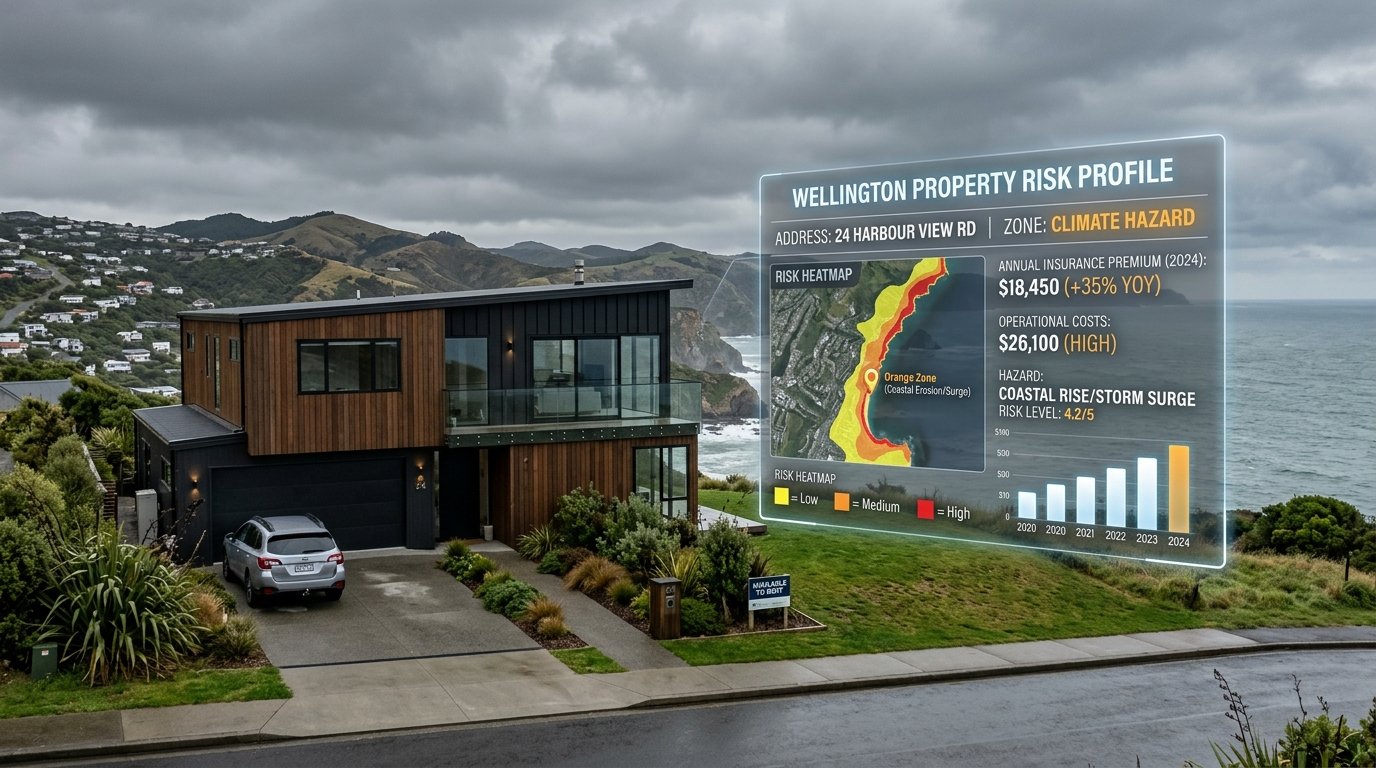
If the property sits in a high-hazard zone where IAG New Zealand or competing underwriters price the annual premium at $6,800, net operating income drops to $25,200. The net yield falls to 2.96%. On an interest-only mortgage of $680,000 at 6.2%, annual debt servicing requires $42,160. The additional $4,300 insurance expense pushes the annual cashflow deficit from negative $12,660 to negative $16,960—a 34% increase in the out-of-pocket cash top-up required from the owner.
For leveraged investors relying on tight margins, an unbudgeted $350-per-month insurance variance can erase the viability of an acquisition entirely.
The Lending and Resale Risk
The consequences of address-level pricing extend beyond annual operating statements. Major retail banks have tightened insurance verification procedures before granting unconditional loan approval. Lenders require proof of full replacement insurance coverage without prohibitive exclusions.
In high-risk pockets of Wellington and the Hutt Valley, buyers frequently discover during finance conditions that some underwriters refuse to take on new business altogether. If only one or two specialty insurers are willing to cover the property, pricing power disappears, leaving the owner captive to premium increases at every annual renewal.
This pricing dynamic also introduces an exit-strategy risk. As future buyers become more sophisticated about address-level total cost of ownership, properties with elevated insurance premiums face lower capitalization rates, extended days on market, and downward valuation pressure.
A Pre-Acquisition Due Diligence Framework
Navigating the Wellington market requires property investors to replace generic cost assumptions with precise underwriting data before signing unconditional contracts.
- Obtain binding insurance quotes during the due diligence period rather than relying on automated online estimates.
- Check council hazard mapping databases for flood overland flow paths, sea-level rise overlays, and liquefaction zones.
- Review the current vendor’s existing policy renewal schedule, paying close attention to specific natural hazard excess clauses.
- Factor a 10% to 15% annual buffer into long-term insurance expense lines for high-hazard addresses to absorb future reinsurance repricing.
- Compare terms across multiple underwriter groups, as appetite for specific micro-locations varies significantly across the market.
The Wellington property landscape continues to offer opportunities for buyers focused on long-term capital growth and tenant demand. However, the era of treating property insurance as a minor, predictable utility cost is over. In today’s market, analyzing the dirt beneath the foundation is just as critical as evaluating the structure itself.