The Backyard Cashflow Multiplier: Unlocking 8%+ Dual-Income Yields via Hamilton’s Minor Dwelling Deregulation
Across Hamilton and the wider Waikato region, residential property investors face a familiar equation. CoreLogic data shows standard standalone residential dwellings in Hamilton trading at median values near $760,000, while average weekly rents sit close to $580. That generates an average gross yield of roughly 4.0% to 4.5%—a return profile that struggles to deliver positive cashflow in an environment where mortgage interest rates remain elevated.
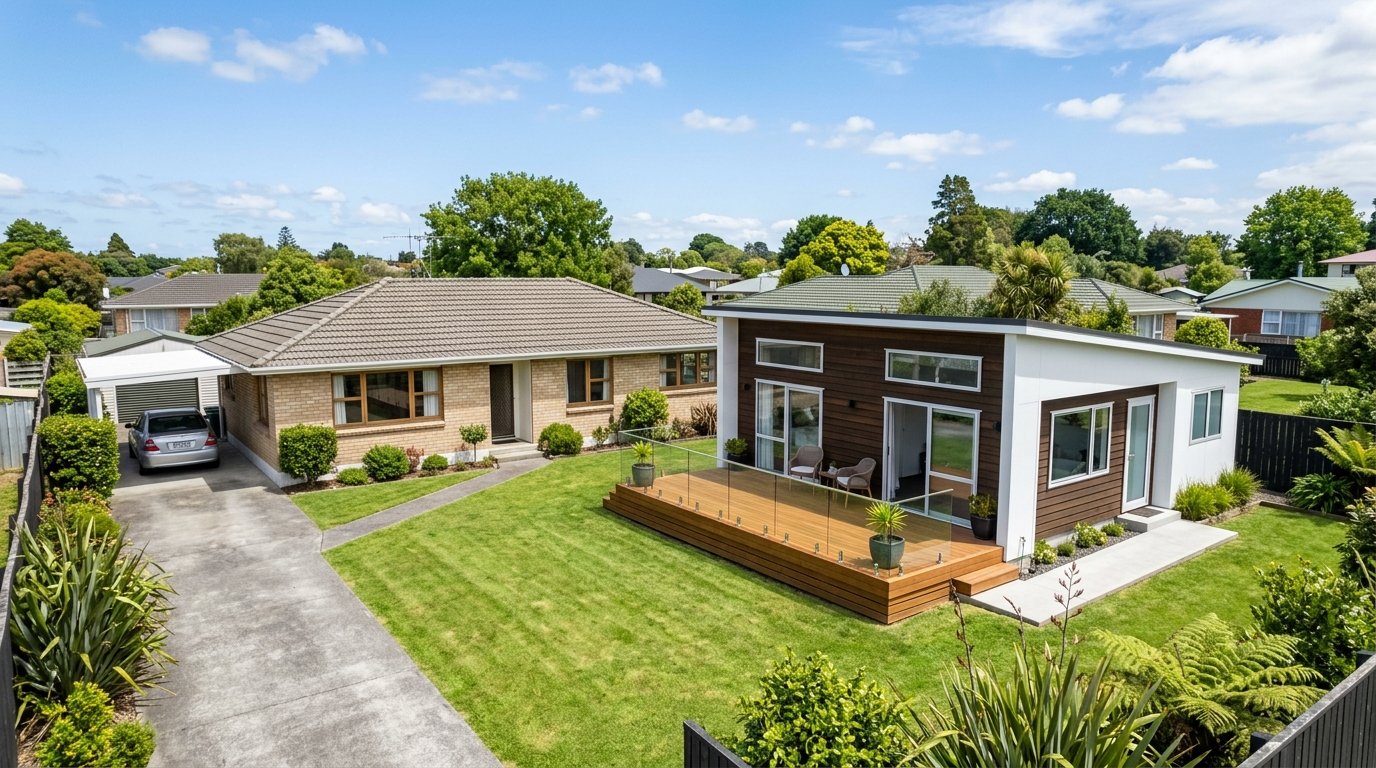
Faced with thin margins on traditional buy-and-hold stock, an increasing number of investors are abandoning traditional land subdivision in favour of secondary dwellings. By taking advantage of national planning reforms and streamlined building regulations, owners are manufacturing dual-income sites on single titles. In doing so, they are locking in blended gross yields exceeding 8% while skipping the substantial capital expense and multi-month delays associated with formal titling.
The Steep Cost of Traditional Subdivision
Subdividing a standard suburban quarter-acre or 800-square-metre section in Hamilton has long been the default strategy for adding residential density. The financial hurdle, however, has grown significantly. A full fee-simple subdivision routinely costs between $100,000 and $160,000 before any construction activity begins on the rear parcel.
These preliminary costs accumulate through several distinct streams:
- Council development and infrastructure contributions, which often exceed $25,000 to $35,000 per additional lot.
- Separate utility connections for power, telecommunications, and Three Waters infrastructure, including individual water meters and wastewater junctions.
- Professional fees for land surveyors, geotechnical engineers, and planning consultants.
- Legal conveyancing, Land Information New Zealand (LINZ) lodgement fees, and resource consent processing expenses.
- Holding costs on capital across council approval timeframes that frequently stretch between 9 and 18 months.
By retaining a single fee-simple title and adding a detached minor residential unit, investors eliminate nearly all of these civil creation costs. The capital can instead be directed into vertical construction, which begins producing rental income months ahead of a typical subdivision timeline.
MBIE Deregulation and the Building Act Overhaul
The operational catalyst behind this trend stems from sweeping regulatory adjustments overseen by the Ministry of Business, Innovation and Employment (MBIE). Through changes modernising the Building Act, the Government has removed the requirement for standard building consents on detached minor dwellings up to 70 square metres, provided the work adheres strictly to the New Zealand Building Code and is carried out or supervised by Licensed Building Practitioners.
Under the guidance framework published by MBIE, property owners are required to submit a Project Information Memorandum (PIM) and notify the local territorial authority prior to construction, followed by a formal completion notice. Because the build bypasses the conventional multi-stage council inspection timetable, the turnaround from site preparation to tenant move-in drops dramatically.
In Hamilton, this national framework aligns with permissive local rules. The Hamilton City Council District Plan and national environmental standards permit detached secondary units on qualifying residential sites without discretionary resource consents, provided the primary site coverage standards, boundary setbacks, and outdoor living area minimums are maintained. For properties located across mature suburbs such as Nawton, Frankton, Enderley, and Melville, where section sizes frequently range from 650 to 900 square metres, the back garden has transformed from an ongoing maintenance liability into productive real estate.
The Yield Mathematics: Manufacturing 8%+ Returns
The financial mechanics of a dual-tenancy strategy become clear when assessing current development and rental metrics across the Waikato market. CoreLogic figures indicate that lower-quartile standalone homes in established Hamilton suburbs often trade between $580,000 and $640,000, typically achieving $530 to $560 per week in rent.
An investor acquiring a property at $620,000 generates approximately $28,080 in annual gross rent at $540 per week, reflecting a baseline yield of 4.53%. By placing a high-spec, two-bedroom prefabricated minor dwelling of 60 square metres on the rear lawn, the financial landscape changes:
- Minor dwelling procurement, transport, foundation piles, and onsite service connections total roughly $190,000 to $210,000.
- Weekly rental income for a brand-new two-bedroom minor dwelling in Hamilton currently commands between $440 and $480 per week.
- Taking the mid-point of $460 per week yields $23,920 annually on an incremental build outlay of $200,000—a marginal gross return on capital of 11.96%.
- Total capital invested across the site reaches $820,000, producing a combined weekly income of $1,000 ($52,000 per annum).
- The blended gross yield across the single title rises to 6.34%.
Where investors target entry-level housing stock purchased at $500,000 to $530,000, or where an existing mortgage-free portfolio asset is retrofitted, the resulting numbers become even more compelling. In scenarios where total capital exposure sits at $710,000 with $1,000 per week in total rent, gross yields cross the 7.3% mark. When minor dwellings are configured to capture higher room rents or placed on properties secured below median values during market lulls, realized gross returns frequently hit 8.0% to 8.5%.
Bank Policy and Lending: The Westpac Position
Financing secondary dwellings previously presented a barrier for everyday residential borrowers, as lenders often viewed unconsented or transportable structures as unsecured personal property. Major trading banks have adjusted their criteria to accommodate factory-built and minor residential options.
Westpac, in particular, has developed dedicated lending policies designed to support off-site modular construction. Through specialized products such as its pre-built home loan framework, Westpac allows borrowers to draw down loan tranches to fund progress payments while the dwelling is under construction in an off-site manufacturing yard. Once delivered, secured to permanent foundations, and connected to site utilities, the debt converts into a standard residential home loan facility.
Lenders also factor secondary tenancy income into their debt-serviceability tests, provided the investor presents a registered valuation or rental appraisal confirming the dwelling is fully self-contained with its own kitchen, bathroom, and private entrance. This recognition enables property owners to service larger borrowing facilities on the back of the newly manufactured cashflow stream.
Operational Risks and Due Diligence
While the economics are compelling, building under minor dwelling exemptions carries structural obligations that investors must not overlook. Council notification remains mandatory, and failure to document compliance through a Licensed Building Practitioner can create title issues when the asset is eventually insured or sold.
Infrastructure capacity also demands upfront analysis. Hamilton’s Three Waters network requires careful verification; older drainage mains may lack the fall or capacity to support an extra household without upgraded pumps or drainage pits. Shared vehicle access and tenant privacy require physical delineation to minimise turnover, and local development contribution fees can still apply to secondary dwellings via the council PIM process.
For portfolio operators across Hamilton and the wider Waikato region, these minor units represent an efficient route to high-yielding, resilient residential cashflow without the friction of formal property development.