Golden Triangle Resilience: Why Hamilton and the Waikato Basin Are Absorbing North Island Capital
While primary metropolitan property markets in Auckland and Wellington continue to navigate prolonged listing cycles and compressed returns, the Waikato Basin is demonstrating remarkable resilience. Situated at the core of the Golden Triangle—the economic zone linking Auckland, Hamilton, and Tauranga that generates over half of New Zealand’s gross domestic product—Hamilton and its neighboring districts are capturing sustained flows of private investment and inter-regional migration.
Data from the Real Estate Institute of New Zealand (REINZ) reveals an underlying sales velocity in the Waikato basin that contrasts sharply with the sluggish absorption rates of its larger northern neighbor. Supported by the full operational efficiency of the four-lane Waikato Expressway, the region has transitioned from an affordable overflow market into an independent economic driver capable of self-sustaining capital attraction.
The Inter-Regional Capital Migration
Stats NZ internal migration records underline a persistent demographic rebalancing across the upper North Island. Auckland has logged sustained net internal migration outflows, with households, skilled professionals, and business operators relocating south along the State Highway 1 corridor.
Affordability remains a principal catalyst. REINZ reporting shows the Waikato regional median sale price holding around $750,000, compared to Auckland’s median hovering near $980,000. In Hamilton city, where the median value sits near $775,000, incoming buyers from Auckland frequently release substantial equity while trading into newer, low-maintenance housing stock.
This demographic flow extends well beyond retirees seeking quiet retirement destinations. The influx entering the Waikato Basin consists heavily of working-age families and mid-career professionals seeking manageable commutes, expanding school networks, and reduced debt burdens. With remote and hybrid work practices firmly embedded, the geographic divide between southern Auckland and northern Waikato has effectively dissolved.
Yield Disparities and Liquidity Metrics
For residential investors, the central draw of the Waikato Basin lies in the combination of dependable cashflow and superior asset liquidity. Data from CoreLogic and REINZ highlights an expanding performance gap between Auckland and Hamilton across fundamental investment benchmarks:
- Gross rental yields: Across suburban Hamilton, gross rental yields average between 4.4% and 5.2%. Established working suburbs such as Frankton and Dinsdale produce yields near 4.8% on median values of approximately $640,000, whereas Auckland residential assets remain constrained at average gross yields between 3.1% and 3.5%.
- Days to sell: REINZ sales velocity indicators show Waikato housing clearing at a brisk pace. Key satellite markets like Cambridge record median days to sell of roughly 32 days, comfortably outperforming the national average of 47 to 54 days.
- Transaction absorption: While buyer hesitation has expanded unsold inventory in Wellington and Auckland, Hamilton entry-level and mid-tier family residences continue to draw steady interest from first-home buyers and local landlords alike.
The ability to secure income yields that offset higher borrowing rates, paired with a lower capital entry point, makes the Waikato Basin a primary beneficiary of private portfolio reallocations.
Peacocke: Unlocking Hamilton’s Southern Growth Corridor
Hamilton City Council’s largest urban expansion, the Peacocke programme, has passed decisive structural milestones that set the framework for long-term housing delivery. Backed by the Crown’s Housing Infrastructure Fund through a $290.4 million package, key transport links and utility backbones are now fully delivered.
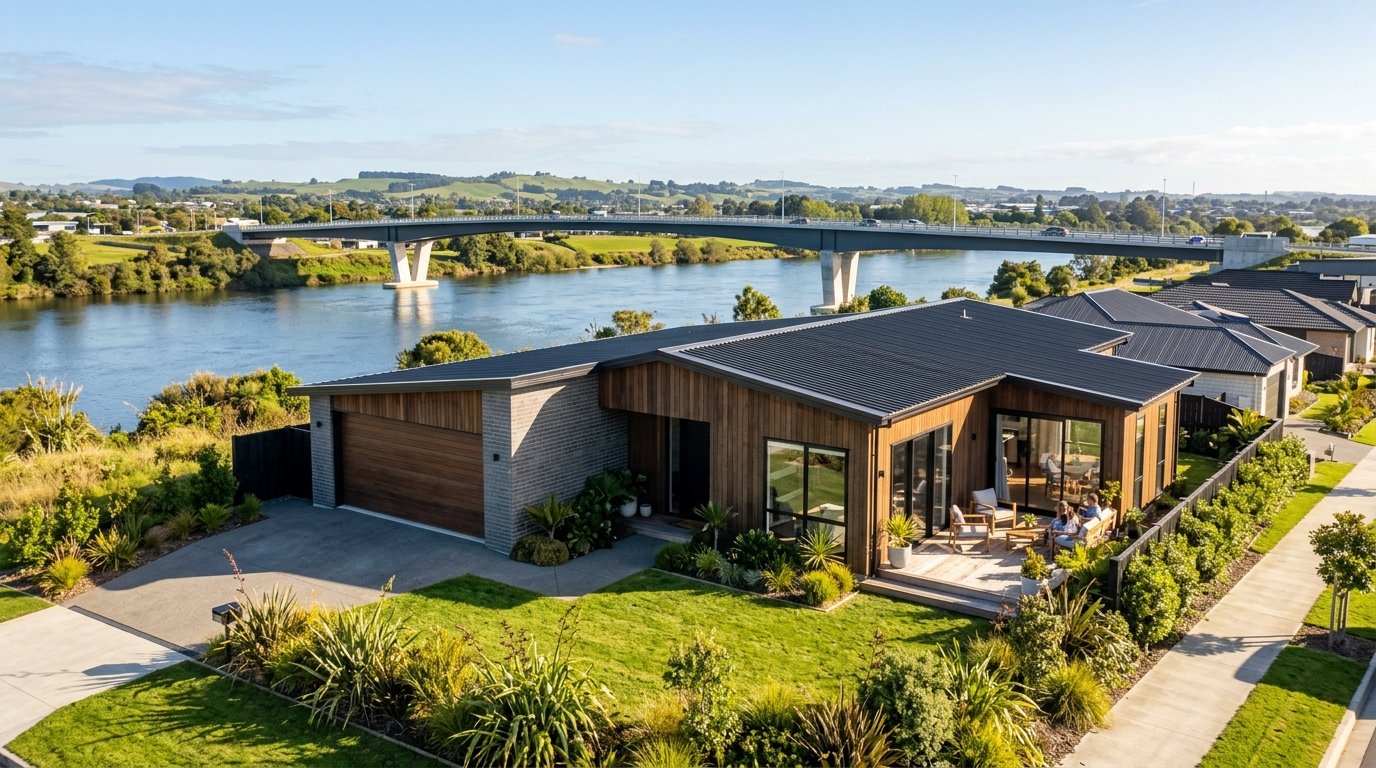
The centerpiece of this expansion, Te Ara Pekapeka o Māhatā—the 215-metre bridge across the Waikato River—has transformed travel times between Hamilton East and the southern growth zone. Complemented by the completion of Whatukooruru Drive, the strategic arterial linking Peacockes Road with State Highway 3, essential services are in place.
The completed infrastructure corridor unlocks 243 hectares of greenfield land zoned for more than 7,400 homes, schools, reserves, and a dedicated seven-hectare commercial town centre. For residential developers, Peacocke offers master-planned certainty backed by modern three-waters networks, avoiding the infrastructure deficits that frequently stall infill development in older metropolitan suburbs.
Ruakura Superhub: The Economic Engine of the Basin
A regional property market cannot sustain prolonged momentum on residential commuting alone. Hamilton’s property fundamentals are supported by massive industrial expansion, anchored by the 490-hectare Ruakura Superhub.
Led by Tainui Group Holdings, the commercial arm of Waikato-Tainui, Ruakura forms an intermodal logistics powerhouse at the direct intersection of the Waikato Expressway and the East Coast Main Trunk rail line. Its scope includes:
- A 30-hectare inland port operated in partnership with the Port of Tauranga, enabling seamless container freight movements across the golden triangle.
- Over 160 hectares of logistics and industrial facilities, housing massive tenant footprints such as Kmart’s 40,000-square-metre distribution centre, Maersk, and Big Chill.
- A billion-dollar joint venture with global investment manager Brookfield to fund and construct up to 70 hectares of additional logistics facilities.
- A master-planned residential community planned to incorporate approximately 3,000 homes beside retail precincts and 50 hectares of restored wetlands.
The concentration of permanent industrial, distribution, and commercial jobs at Ruakura provides an economic bedrock that safeguards tenant demand and household incomes throughout the basin.
Cambridge and Waipa: Capitalising on Satellite Demand
To the south-east of Hamilton, the historic township of Cambridge in the Waipa District represents the basin’s premium lifestyle location. Connected directly to Hamilton via the continuous four-lane expressway, Cambridge has developed into an executive residential market.
CoreLogic and REINZ data show Cambridge carrying an average home valuation of approximately $1.09 million. Despite that higher price band, properties in the town maintain rapid liquidity, with median days to sell sitting at 32 days.
Auckland owner-occupiers liquidating high-value properties in central or northern Auckland find strong value in Cambridge due to its high-performing schools, boutique town center, and world-class sporting facilities. The momentum in Cambridge has rippled into adjacent Waipa settlements such as Pirongia and Te Awamutu, adding broad geographic depth to regional transaction volumes.
The Structural Outlook for Waikato Assets
The sustained resilience of Hamilton and the wider Waikato Basin stems directly from strategic, long-horizon public and private capital deployment. The completed transport expressways, major bridges like Te Ara Pekapeka o Māhatā, and heavy freight assets like Ruakura have integrated the basin into a cohesive economic district.
With entry pricing sitting hundreds of thousands below Auckland, gross yields reliably outperforming metropolitan averages, and inventory moving faster than national baselines, the Waikato property market offers exceptional structural stability. As capital continues to seek dependable fundamentals over speculative capital gains, the core of the Golden Triangle remains well positioned to absorb North Island growth.