The Defective Flats Plan Trap: Why Overlooking Cross-Lease Alterations in Mount Maunganui Can Cost Buyers $25,000
Mount Maunganui represents one of New Zealand’s most sought-after coastal enclaves, where median dwelling values consistently sit above $1.2 million according to CoreLogic property records. Yet beneath the premium price points of this coastal strip, an insidious legal vulnerability threatens unsuspecting purchasers: the defective cross-lease flats plan. Across Tauranga and the Western Bay of Plenty, thousands of residential properties remain bound by cross-lease arrangements executed decades ago. When prospective buyers fail to verify the physical boundaries of a home against the official plan registered with Land Information New Zealand (LINZ), the financial fallout can reach $25,000 and derail mortgage lending days before settlement.
The Anatomy of a Cross-Lease Title Defect
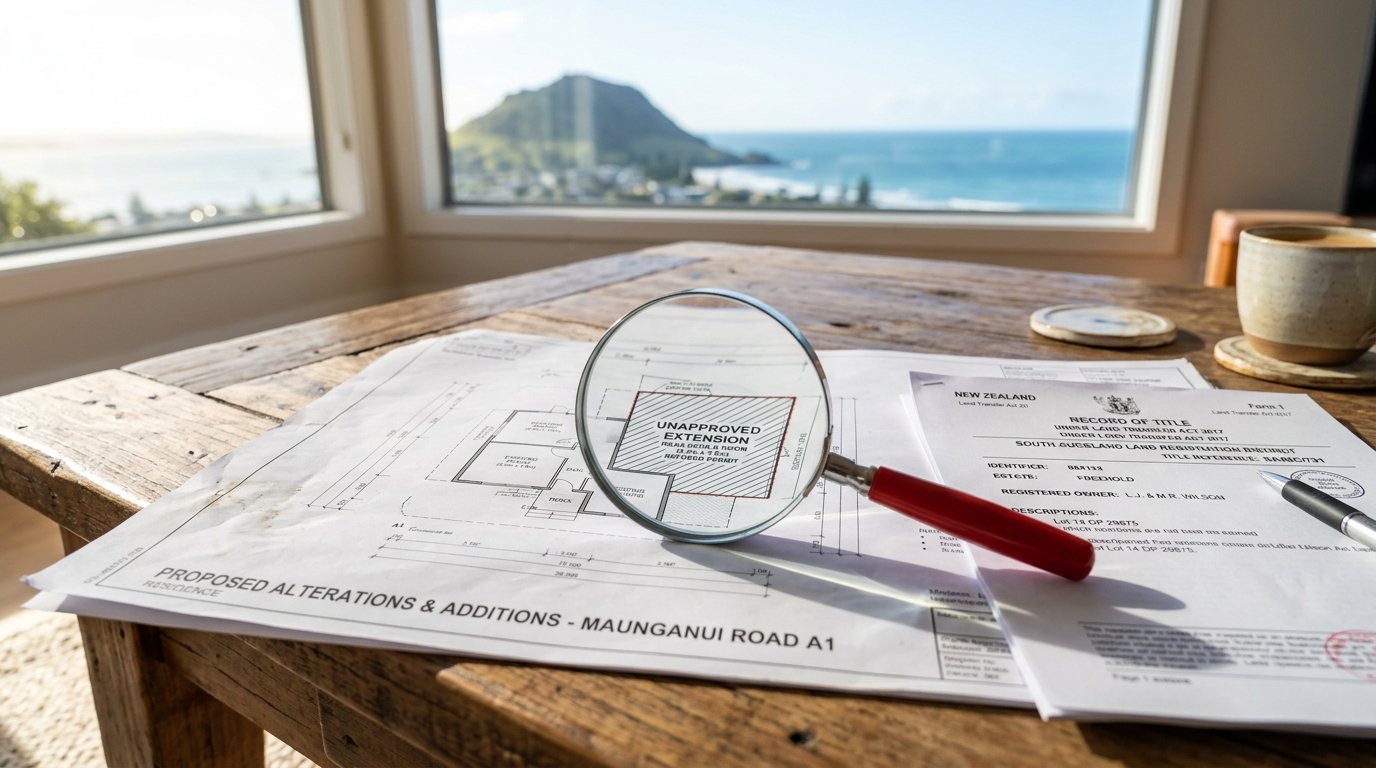
Unlike standard fee-simple ownership, a cross-lease structure divides land ownership among multiple parties while granting each owner a long-term lease over their individual footprint. The defining document attached to the record of title held by Land Information New Zealand is the flats plan. This surveyed diagram establishes the precise outline of the dwelling, garage, exclusive-use yards, and shared common areas.
A cross-lease title becomes legally defective whenever the physical reality on the ground does not mirror the registered diagram. If a past owner enclosed an external porch, constructed a conservatory, converted a carport into a lock-up garage, or extended an exterior wall, the footprint has altered. Crucially, obtaining a building consent from Tauranga City Council or Western Bay of Plenty District Council does not rectify the underlying title. Council consent confirms structural and safety compliance under the Building Act; it does not amend the proprietary property rights recorded on the LINZ register.
The Financing Shock at Final Conveyancing
The standard agreement for sale and purchase published by the Auckland District Law Society and the Real Estate Institute of New Zealand provides explicit protections regarding title requisitions. Clause 5 mandates that vendors transfer good title. When a purchaser identifies a discrepancy between the dwelling footprint and the registered flats plan, they hold the legal right to object and demand rectification prior to settlement.
The greater hazard emerges when buyers omit this physical check during preliminary due diligence and declare their purchase unconditional. New Zealand major retail lenders enforce strict criteria regarding property securities. If a bank valuer or conveyancing solicitor identifies an unrecorded structural extension during pre-settlement checks, mortgage underwriters routinely freeze the drawdown of funds. Lenders view an unrecorded addition as an unsecured asset because the structure legally encroaches upon common property or breaches the underlying lease covenants. When bank funding stalls 48 hours prior to scheduled settlement, buyers face escalating default interest rates, financial penalties, and the imminent risk of losing their deposit.
Deconstructing the $25,000 Rectification Bill
Remedying a defective cross-lease title requires a process virtually identical to a full subdivision. Rectifying the title is neither swift nor inexpensive. Rectification expenses routinely accumulate to $25,000 through multiple statutory and professional phases:
- Cadastral surveying fees: Engaging a licensed cadastral surveyor to remeasure the structural footprints, establish boundary offsets, and generate a new deposited plan costs between $5,000 and $8,000.
- Territorial authority consent: Securing resource consent and section 223/224 certification through Tauranga City Council or Western Bay of Plenty District Council incurs application fees and planner billings ranging from $3,000 to $5,500.
- Legal conveyancing and cross-lease deeds: Legal practitioners must draft replacement leases, execute surrenders of prior leases, and coordinate documentation across all registered proprietors, demanding $6,000 to $9,000.
- Mortgagee consent charges: Every owner sharing the underlying fee-simple parcel must obtain formal consent from their respective lending institutions to surrender and re-register mortgages, generating bank processing and legal fees between $1,500 and $3,000.
- LINZ registration fees: Lodging the updated survey plan, obtaining new title records, and registering updated lease instruments with Land Information New Zealand adds $1,000 to $1,800.
Beyond direct professional expenses, time represents an immense financial liability. Amending a flats plan through local councils and LINZ requires four to six months. If a buyer must finance emergency bridge facilities or negotiate prolonged settlement extensions, carrying costs can quickly elevate total project expenditure well beyond original estimates.
Why the Bay of Plenty Coastline Faces Concentrated Risk
Data from CoreLogic and Land Information New Zealand indicates that cross-lease properties account for approximately 20 to 25 percent of the mature housing stock throughout the wider Tauranga urban basin. In Mount Maunganui, this proportion is heavily concentrated in the streets running parallel to Marine Parade and along the avenues approaching the main retail strip.
During the property booms of the 1970s and 1980s, developers utilized cross-leases to subdivide traditional quarter-acre coastal sections without satisfying the stringent subdivision standards imposed on freehold developments. In subsequent decades, generations of owners modified their coastal properties. Modest two-bedroom baches were expanded with sunrooms, sheltered entertaining areas were closed in with joinery, and detached sleepouts were constructed to accommodate seasonal holiday influxes.
Because many of these modifications occurred before computerized land registries and rigorous compliance checks took hold, hundreds of properties entered the current decade with unrecorded structural alterations. In today’s tighter regulatory and credit environment, these legacy additions are surfacing as costly legal encumbrances.
Essential Due Diligence Steps for Prospective Purchasers
Buyers targeting the Mount Maunganui and Western Bay of Plenty property markets must execute disciplined verification procedures to avoid inheriting defective titles:
- Inspect the registered flats plan on site: Request the official title document and deposited plan from Land Information New Zealand prior to submitting an offer. Physically walk the perimeter of the dwelling with the plan in hand, verifying that every exterior wall, attached structure, and garage corresponds with the diagram outline.
- Distinguish between building permits and title updates: Never assume that historic council documentation or code compliance certificates validate the title. Confirm whether past permitted additions were formally registered on the flats plan.
- Include protective title requisition conditions: Ensure sale and purchase agreements retain robust vendor warranties regarding structural alterations and cross-lease compliance, rather than signing generic unconditional clauses at auction.
- Consider freehold conversion early: In scenarios where a title is defective, evaluate whether converting the entire cross-lease to fee-simple freehold presents a more viable long-term investment. Converting to freehold removes the restrictive lease structure entirely and often adds measurable value to the underlying asset.
Cross-lease properties continue to offer an accessible entry route into prime coastal suburbs, yet the operational rules governing their titles demand precision. Verifying the accuracy of registered plans protects purchasers from sudden lending refusals and preserves project capital that would otherwise vanish into surveying and council fees.