The Short-Stay GST Trap: Why Selling an Airbnb in Queenstown Can Trigger an Unexpected $180,000 Tax Bill
The High-Yield Allure of Southern Lakes Holiday Homes
Acquiring a holiday home across Queenstown and Wanaka has long represented the dual ambition of personal leisure and capital growth. Driven by international tourism and constrained geography, the Queenstown-Lakes district consistently posts some of the highest residential valuations in the country. Real Estate Institute of New Zealand (REINZ) data places the median sales price in the Queenstown-Lakes territory well above $1.5 million, with premium lakeside suburbs and Wanaka properties commanding figures substantially higher.
Faced with elevated mortgage interest rates and rising council rates, many buyers look to short-term rental platforms such as Airbnb and Bookabach to offset ownership costs. Nightly tariffs in peak ski or summer seasons routinely exceed $500 to $800 per evening. Marketing a residential dwelling to tourists promises cash flow that traditional long-term tenancies cannot match. Yet behind this cash flow sits one of the most punitive fiscal traps in New Zealand property: the Goods and Services Tax Act 1985.
How Short-Stay Rentals Enter the GST Net
Under the Goods and Services Tax Act 1985, standard residential rental accommodation provided to long-term tenants is an exempt supply. Landlords renting to permanent tenants do not charge GST on rent, cannot claim GST on holding costs, and face no GST liability when selling the real estate.
Short-term visitor accommodation operates under completely different statutory principles. Inland Revenue (IRD) classifies accommodation provided for stays of less than four consecutive weeks as a commercial supply rather than an exempt residential tenancy. When an owner provides short-stay accommodation on a regular basis, they are carrying on a taxable activity.
The critical tipping point is the mandatory registration threshold. Any person or entity whose gross turnover from all taxable activities exceeds $60,000 within any 12-month period must register for GST with Inland Revenue. In Queenstown, achieving $60,000 in gross revenue is remarkably straightforward. An owner renting a home for $600 per night needs only 100 nights of occupancy across an entire year to cross the threshold. Many buyers also voluntarily register upon acquisition, persuaded by the prospect of claiming back tens of thousands of dollars in GST on furnishing packages, repairs, management fees, and utilities.
The Gross Exit Calculation: The Anatomy of a $180,000 Shock
The trap snaps shut not when the property is generating rental revenue, but years later when the owner decides to sell. Once a property becomes an asset used in a GST-registered activity, its ultimate disposal represents a taxable supply under the Goods and Services Tax Act 1985.
Consider a standard scenario in the Queenstown-Lakes market. An investor purchases a standalone home or apartment for $1.2 million, registers for GST, and operates it as an Airbnb for four years. The property market appreciates, and the owner negotiates an unconditional sale for $1,380,000 inclusive of GST.
Because the vendor is GST-registered and used the asset in their taxable activity, Inland Revenue requires output tax on the transaction. The GST component embedded in a $1,380,000 sale is calculated at three-twenty-thirds of the gross consideration, which amounts precisely to $180,000.
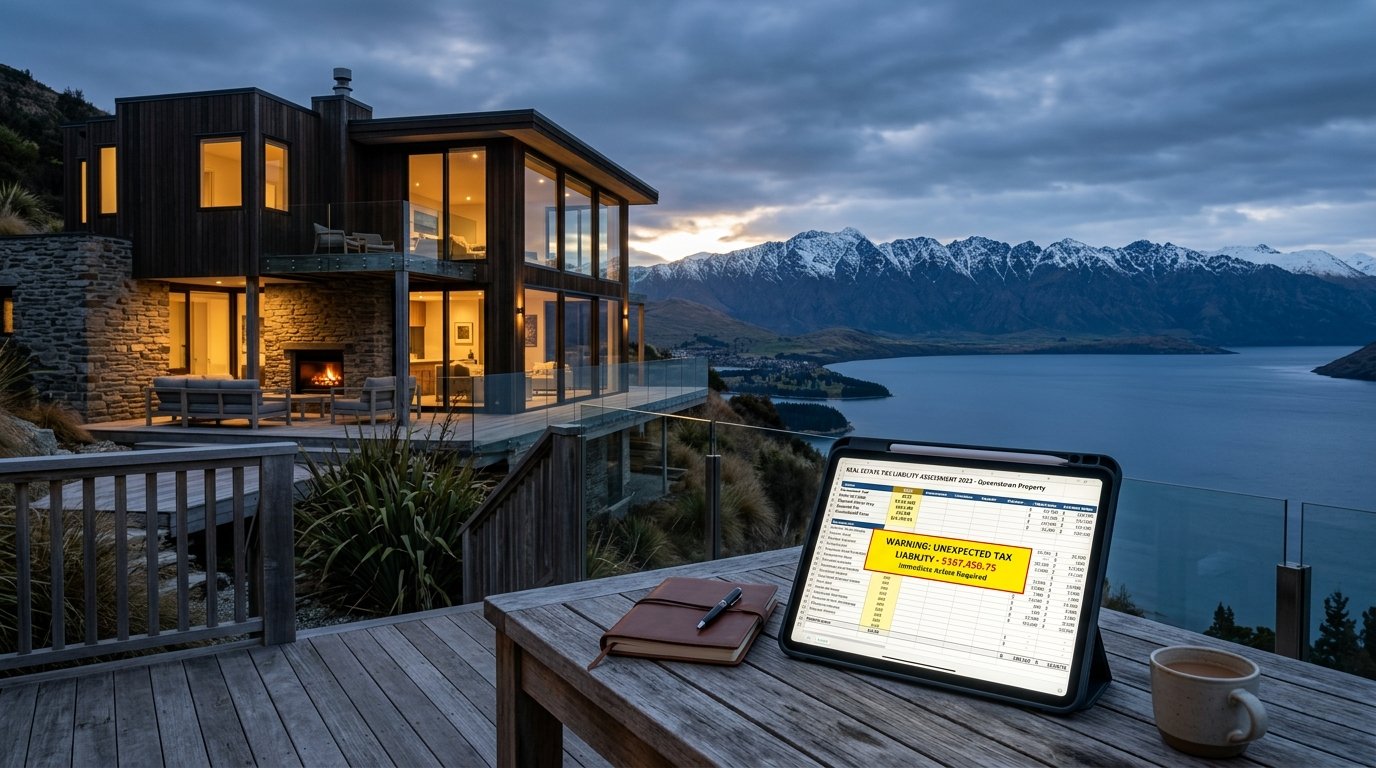
If the vendor mistakenly believed the sale was exempt residential property, that entire $180,000 liability must be paid directly to Inland Revenue out of the vendor’s net equity at settlement. In situations where an owner had significant leverage, this unexpected tax bill can wipe out years of accumulated capital gains and leave the vendor with a net cash deficit.
The Breakdown of Compulsory Zero-Rating
Sellers often assume commercial property transaction rules will protect them through compulsory zero-rating under section 11(1)(mb) of the Act. While it is true that transactions between two GST-registered entities can be zero-rated to 0% GST, that relief requires the buyer to be GST-registered and intending to use the asset in a taxable activity.
In Queenstown and Wanaka, the buyer profile for residential dwellings is heavily weighted toward private individuals. The incoming purchaser is frequently an owner-occupier relocating to the region, a retiree, or a family seeking a private holiday home without commercial intent. An unregistered buyer will not, and cannot, agree to zero-rating. They submit an offer on standard standard residential terms, and the contract price is deemed inclusive of GST unless expressly stated otherwise.
Attempting to add ‘plus GST’ to a residential sale contract in Queenstown regularly collapses negotiations. A private buyer seeking a home will not pay an additional 15% premium above market value to cover the vendor’s historical tax structure.
Misconceptions Surrounding the 2024 Marketplace Rules
Legislative changes introduced on 1 April 2024 have deepened owner confusion. Under the platform economy rules, online marketplace operators like Airbnb are required to collect and remit 15% GST on bookings directly to Inland Revenue. For unregistered hosts, platforms return an 8.5% flat-rate credit to recognise underlying costs.
A widespread misconception has emerged that because the platform handles the booking GST, owners no longer need to worry about tax registration or capital exposure. This assumption is legally incorrect.
- The platform rules do not override the statutory $60,000 turnover threshold across all personal taxable supplies.
- An owner who earns more than $60,000 annually must still register for GST directly with Inland Revenue.
- Crucially, if an owner is registered, the underlying real estate remains tethered to the GST regime. Marketplace rules change the mechanics of booking collection, but they do not shield the underlying real estate from output tax upon sale.
The Exit Dilemma: De-registration and Apportionment
Owners who realize they are caught in the GST net often ask whether they can cancel their GST registration before listing the property with an agent. Inland Revenue rules prevent this straightforward escape. Under section 5(3) of the Act, when a person ceases to be registered, they are deemed to have supplied all assets on hand at open market value immediately before de-registration.
De-registering a Queenstown property valued at $1.5 million simply triggers the 15% GST output liability at the date of deregistration, requiring immediate cash payment to Inland Revenue without sale proceeds to fund it.
While amendments in the Taxation (Annual Rates for 2022-23, Platform Economy, and Remedial Matters) Act 2023 introduced narrow apportionment rules that allow certain assets to be extracted from the GST net by repaying previously claimed input deductions, qualifying criteria are complex. Properties purchased with input deductions claimed, or those acquired primarily for commercial accommodation, face severe statutory restrictions.
Key Takeaways for Southern Lakes Property Owners
Property owners navigating the Queenstown and Wanaka markets must balance short-term income optimization against long-term capital preservation.
- Gross revenue checks: Monitor total earnings closely. Reaching $60,000 in gross revenue triggers mandatory registration, permanently changing the tax profile of the asset.
- Input tax caution: Refrain from voluntarily registering for GST simply to claim small deductions on chattels and minor repairs, as doing so brings multi-million-dollar real estate into the tax net.
- Professional modeling: Ensure tax advisors assess the exit strategy before taking a property live on digital marketplaces.
- Contract awareness: When selling, review standard REINZ and ADLS contract schedules to confirm whether the sale is inclusive or exclusive of GST before signing.
The gap between short-stay rental returns and long-term residential yields can evaporate rapidly when a property sale triggers an unbudgeted six-figure tax bill. In high-value resort markets, managing GST obligations requires the same rigor as securing financing or negotiating purchase prices.