The Existing-Stock Arbitrage: Capitalising on Auckland’s Discounted Terraced Housing Under 100% Interest Deductibility
A quiet transformation is taking place across Auckland’s residential investment landscape. For the past three years, private landlords faced punitive tax settings and elevated financing costs that turned leveraged property acquisitions into significant cashflow drains. Recent structural shifts in taxation policy alongside an enduring supply overhang in suburban medium-density housing have inverted that calculation. Small-scale property investors are stepping into the Auckland market to exploit an emerging pricing disparity: heavily discounted existing terraced housing delivering near cashflow-neutral yields from day one.
The Policy Distortion and the Return to Parity
Between March 2021 and early 2024, the tax code heavily penalised purchases of existing residential dwellings. Under previous government directives, Inland Revenue (IRD) phased out the ability to deduct mortgage interest against rental income on established properties, while granting a twenty-year exemption to new builds. This policy bifurcated the housing market. Investors chased new developments at significant premiums simply to preserve tax deductibility, while existing properties required substantial out-of-pocket top-ups to service debt.
The policy landscape has since reversed. Following the legislative adjustments enacted by the Coalition Government, the deductibility of mortgage interest on existing properties was restored to 80% for the 2024/25 tax year, before returning to a complete 100% deduction on 1 April 2025. By reinstating equal treatment under Inland Revenue rules, the artificial incentive to pay a developer premium for new builds has disappeared. Landlords can now offset every dollar of mortgage interest incurred on established stock, fundamentally altering the post-tax net yield equation.
Suburban Supply Dynamics and the Manukau Correction
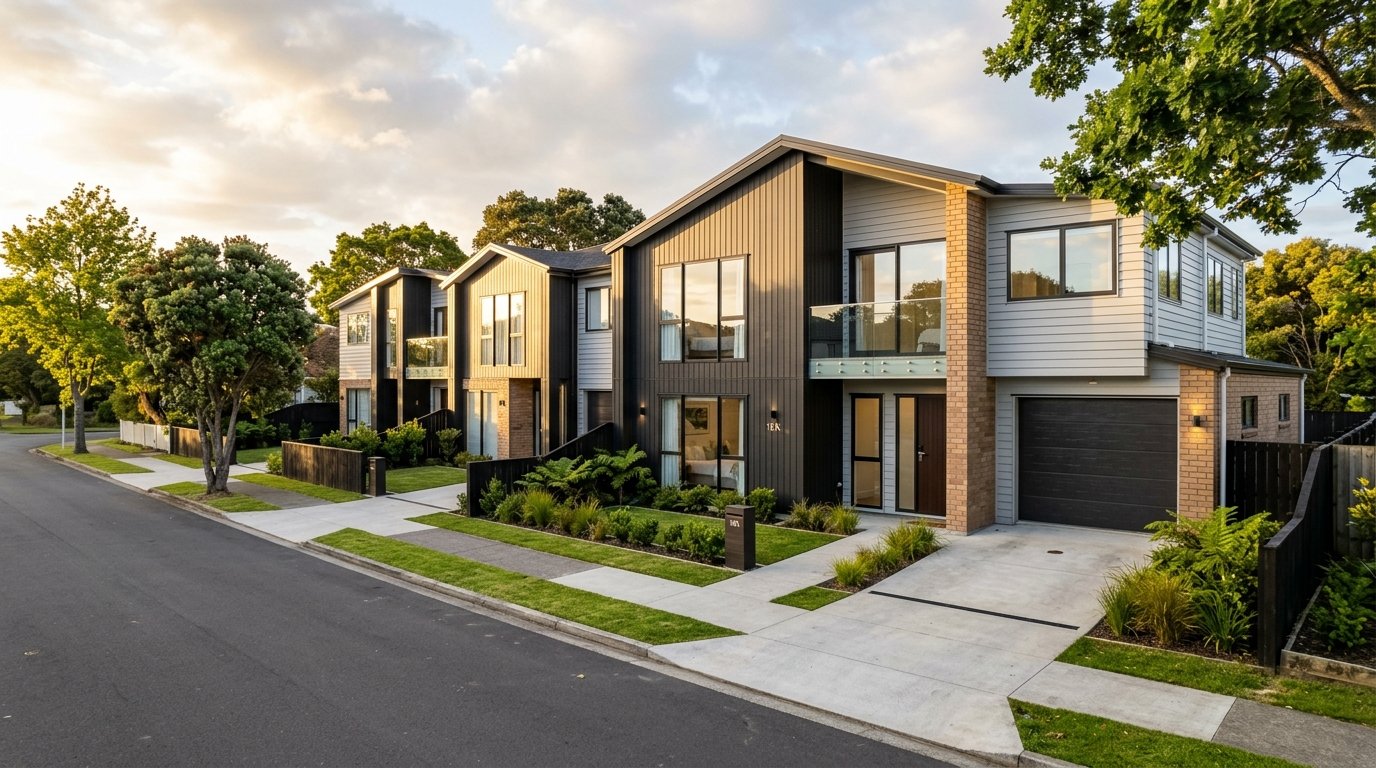
While tax rules restored demand incentives, an historic surge in medium-density completions has provided the supply catalyst. The legacy of the Auckland Unitary Plan, compounded by previous Medium Density Residential Standards (MDRS), generated record-breaking consent volumes across greater Auckland between 2020 and 2023. As those projects reached completion, developers flooded outer suburban nodes with two- and three-bedroom attached homes.
CoreLogic NZ figures illustrate the depth of the resulting price adjustment. Nationwide property values remain roughly 16% to 18% below their early 2022 peaks, but the correction in Auckland’s terraced segment has been pronounced. In southern hubs such as Manukau, Papatoetoe, and Mangere, values for two- to three-bedroom terraced dwellings contracted by 20% to 25% from peak levels. Completed units that changed hands off-the-plan for $820,000 to $870,000 during the market crest have regularly traded in the secondary market between $640,000 and $710,000.
CoreLogic NZ property data shows that while standalone houses have begun tracking horizontally in select central suburbs, the deep inventory of multi-unit stock in South Auckland continues to depress median sale prices. Elevated active listing counts have handed leverage directly to buyers. Vendors who bought off-the-plan in 2021 and now face settlement distress or resetting interest rates are meeting the market, creating an entry point for calculated capital allocation.
Yield Economics: The Cashflow-Neutral Equation
The convergence of lower entry prices, firm market rents, and easing mortgage interest rates has allowed small-scale buyers to structure purchases that do not require monthly owner contributions. Consider an acquisition of an existing two-bedroom, two-bathroom townhouse in the Manukau catchment purchased for $660,000:
- Acquisition Price: $660,000
- Deposit (20% via equity release): $132,000
- Borrowing Requirement: $528,000
- Weekly Rental Appraisal: $650 per week ($33,800 gross annually)
- Gross Rental Yield: 5.12%
On the financing side, retail lending rates have pulled back from their cyclical peaks. Major trading banks, led by competitive carded offers from ANZ and other tier-one lenders, have brought one-year and two-year fixed investor mortgage rates down into the mid-to-high 5% bracket. At a 5.75% fixed mortgage rate, annual interest payments on a $528,000 loan balance total approximately $30,360.
Prior to the tax changes, when Inland Revenue allowed zero interest deductions, an investor in the 33% or 39% marginal tax bracket faced thousands of dollars in tax liabilities on ‘phantom profits’—rental income taxed before interest expenses. At 100% deductibility, the full $30,360 in interest is deductible against the $33,800 gross rent. After factoring in council rates, insurance, residents’ society levies, and standard property management deductions, the taxable net income approaches zero, leaving the property self-sustaining on an interest-only basis.
Why Existing Stock Beats Off-the-Plan Builds
Investors are intentionally bypassing off-the-plan developments in favour of stock built between 2021 and 2023 for several structural reasons:
- Elimination of Completion Risk: Buying completed, existing townhouses removes developer insolvency risk, sunset clause complications, and construction delays.
- Operational Transparency: Properties with two to four years of operational history have established body corporate or residents society fee tracks, revealing actual maintenance costs rather than developer estimates.
- Immediate Tenant Cashflow: Established units can be tenanted immediately upon settlement, avoiding months of debt servicing during delayed build schedules.
- De-risked Valuation: The initial post-completion price depreciation has already occurred, shielding the incoming purchaser from the initial value drop typical of brand-new retail assets.
Lender Appetite and Credit Considerations
Retail banks have supported this pivot, though with disciplined credit screening. ANZ and other mainstream lenders continue to assess borrowers through debt-to-income (DTI) frameworks and serviceability test interest rates that remain higher than standard rack rates. Even so, the combination of lower nominal rates and reduced purchase prices makes established suburban units far easier to clear through credit underwriting than multi-million dollar standalone houses in inner Auckland.
CoreLogic NZ Buyer Classification records confirm that multiple property owners (MPOs) with modest portfolios—those holding two to four properties—have steadily reclaimed market share throughout the past year. Rather than chasing speculative long-term capital gain, these operators are treating property as an income-producing asset class where yield stability takes priority over rapid asset inflation.
Outlook for the Medium-Density Sector
The window for this pricing arbitrage will depend on how quickly Auckland absorbs its remaining medium-density supply. New residential building consents have trended sharply lower from their 2022 peaks, dropping by more than 30% across the region. With construction pipelines drying up and construction costs remaining elevated, the flood of new townhouse completions will slow to a trickle over the next eighteen months.
As population growth continues and housing supply tightens, the surplus inventory across pockets like Manukau will gradually clear. For landlords positioning portfolios today, the restoration of 100% interest deductibility coupled with motivated vendor discounting offers a rare window: an entry point into the country’s largest urban economy where rental income fully pays for the asset.