Beyond the Peak: Why Queenstown-Lakes Is Surging Ahead While the Rest of NZ Stabilises
A Market Operating on Its Own Axis
While the wider New Zealand residential property market navigates a prolonged phase of consolidation, the Queenstown-Lakes District continues to demonstrate an entirely different trajectory. Latest figures from the Real Estate Institute of New Zealand (REINZ) show national median prices moving sideways, settling around $760,000 to $780,000 as higher debt-servicing costs and inventory overhang dampen buyer momentum in main metropolitan centres like Auckland and Wellington. In contrast, Queenstown-Lakes has not merely held ground; it has climbed beyond its previous peak, recording an approximate 8% annual value gain.
This sustained outperformance is not an anomaly of short-term volatility. Rather, it reflects structural fundamentals unique to the Southern Lakes. The interplay of rigid geographical limits on developable land, strict planning frameworks, and deep pools of equity-rich capital creates a market insulated from the standard pressures weighing on conventional residential centres.
The Data: Divergence in Key Metrics
REINZ sales data reveals clear divergences across several headline measures:
- Queenstown-Lakes median sale prices have consolidated well above $1.6 million, reaching new historical highs.
- The REINZ House Price Index for the district grew near 8% over the past 12 months, whereas the national index tracked virtually flat with subtle regional contractions.
- Median days to sell in the Southern Lakes sit between 28 and 35 days, significantly outperforming the national average of 48 to 52 days.
- Listing inventory across the district has contracted by more than 10% year-on-year, running counter to the stock accumulation seen in upper North Island markets.
Where suburban markets in Auckland or Christchurch have experienced buyer hesitation due to interest rate caution, transactions in the Lakes district have retained clear liquidity. Properties brought to auction or deadline sale continue to attract multiple unconditional bidders, particularly in mid-tier to upper-tier brackets.
Geographical Limits and Development Choke Points
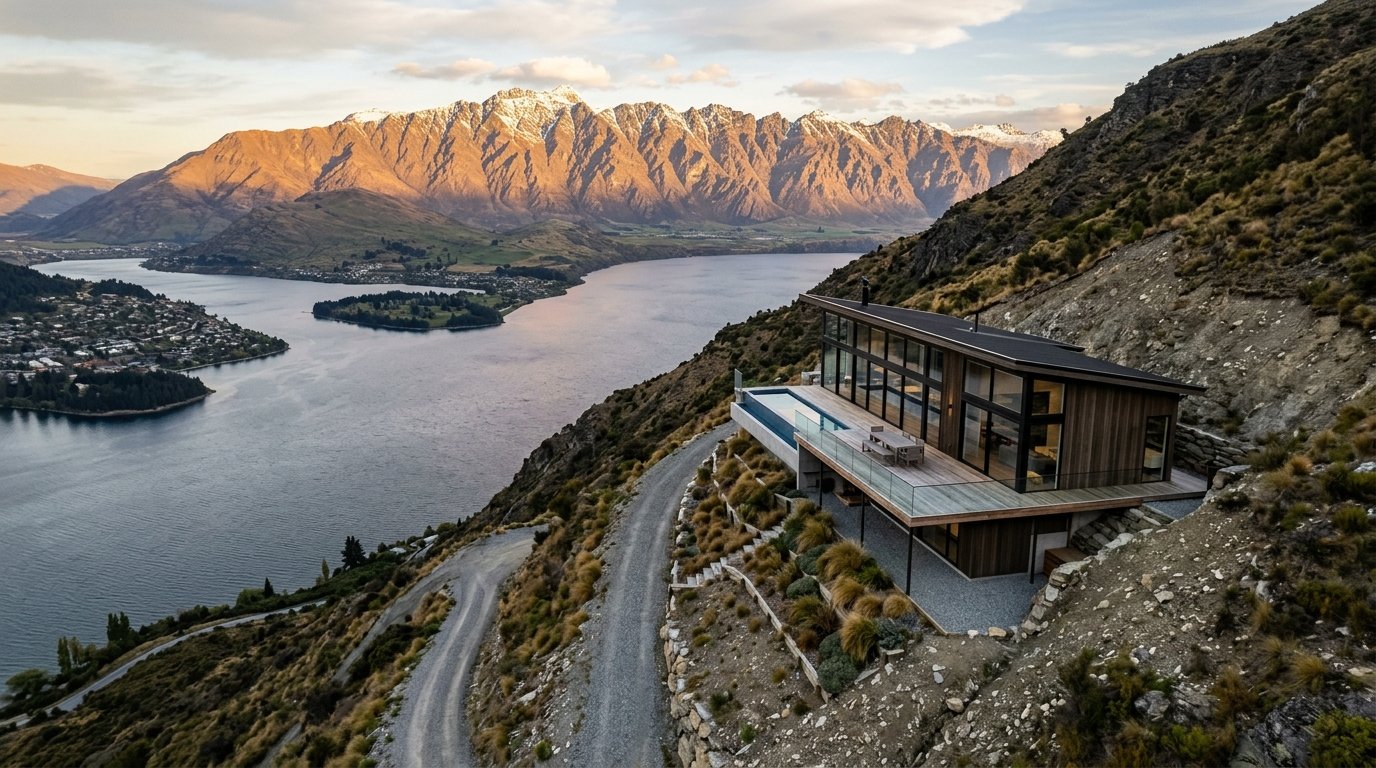
The primary driver behind this persistent upward pricing pressure is physical land scarcity. Unlike horizontal growth corridors in Canterbury or the Waikato, Queenstown-Lakes cannot easily expand outward. The basin is hemmed in by glacial lakes and steep alpine topography, leaving a finite quantum of buildable terrain.
Planning restrictions add another layer of limitation. Outstanding Natural Landscape classifications, stringent height controls, and infrastructure capacity caps in Queenstown, Frankton, and Wanaka make greenfield subdivision complex and expensive. Development contributions, geotechnical engineering costs, and arterial roading constraints keep the pipeline of newly completed dwellings well below population and visitor demand. This structural deficit ensures that new supply cannot easily dilute established asset values.
Performance Across Wanaka, Arrowtown, and Queenstown
The strength of the district is shared across its distinct micro-markets, each serving unique buyer segments:
In Queenstown proper, demand remains anchored across both owner-occupier lifestyle properties and short-term visitor accommodation assets. Strong tourism volumes and tight rental vacancy rates continue to bolster returns, drawing steady enquiry from domestic purchasers seeking dual-purpose holiday homes.
Wanaka continues its ascent as a premier destination for permanent relocation and premium family residences. With median values pushing above $1.5 million, buyer demand has been driven by executives, business owners, and retirees seeking space, lake proximity, and community infrastructure. High-end subdivisions in Wanaka have witnessed strong land clearance rates, even as national building consent numbers have dropped.
Arrowtown remains the district’s most supply-constrained enclave. With its strict heritage precinct guidelines, finite urban boundaries, and negligible greenfield capacity, turnover in Arrowtown is low. When residential properties do reach the market, competition is fierce, maintaining median valuations that frequently surpass the wider basin average.
The Central Otago Ripple Effect
The momentum within Queenstown-Lakes is generating noticeable spillover into neighbouring Central Otago. As entry-level pricing in Queenstown pushes standard three-bedroom homes beyond the reach of local service workers and first-home buyers, peripheral hubs are absorbing the overflow.
Cromwell, located roughly 45 minutes from both Queenstown and Wanaka, has transformed into a strategic residential and commercial base. Driven by relatively more accessible price points—averaging around $750,000 to $850,000—Cromwell is capturing steady owner-occupier demand alongside light-industrial development. Further down the valley, towns such as Alexandra and Clyde are also recording firm interest from buyers seeking lifestyle properties and vineyard estates at a fraction of Lakes-district prices.
Capital Profiles: Equity Over Leverage
A critical factor distinguishing the Queenstown-Lakes market from metropolitan regions is the capital profile of its buyer base. While first-home buyers and highly leveraged investors in major cities face strict debt-to-income limits and elevated retail mortgage rates, Queenstown-Lakes purchasers typically bring substantial equity to the table.
Transactions across Queenstown, Wanaka, and Arrowtown frequently involve cash buyers, equity transfers from previous primary residences, or high-net-worth individuals diversifying their portfolios. In addition, trans-Tasman interest has accelerated. Australian buyers, alongside returning expatriates from North America and Europe, view the region as a secure, high-amenity haven. Because these transactions are far less sensitive to local interest rate adjustments, purchasing activity has remained insulated from the borrowing constraints affecting typical domestic buyers.
Strategic Outlook
Looking ahead, the fundamental imbalance between restricted supply and enduring lifestyle appeal looks set to sustain Queenstown-Lakes at the top of national performance rankings. While local economic hurdles remain—including workforce housing shortages and infrastructure funding requirements—the asset class itself retains exceptional pricing power.
For investors, advisers, and property professionals, the Southern Lakes market serves as a case study in geographical moat economics. While the broader New Zealand housing market moves through its gradual cyclical recovery, Queenstown-Lakes proves that when severe scarcity meets unconstrained capital, values can comfortably push beyond historical peaks.